


⸻
There is a kind of love that will destroy you.
On November 4, 2025, New York City elected Zohran Kwame Mamdani as its first Muslim and first South-Asian mayor—an overwhelming, landslide victory that stunned even political insiders. His campaign was drenched in the kind of language that seduces exhausted democracies: “care,” “compassion,” “community,” “justice from the ground up.” At his victory rally, Mamdani declared not that he would govern all New Yorkers, but that his win was “a mandate for a new kind of politics”—a politics built on radical economic restructuring, rent freezes, public ownership, and a re-engineered moral vision of the city. His supporters cheered, not because they understood the full implications, but because he made compassion sound like salvation.
Two months earlier, when Mamdani married his wife in an opulent ceremony in New York, the press described it as a celebration of “love,” “hope,” and “the future of the city.” The symbolism was intentional: a young immigrant, a man of color, a Muslim democratic socialist, stepping into both matrimony and political destiny as the embodiment of a gentler revolution. But beneath the soft aesthetics lay the hard architecture of his ideology. Mamdani was already on record advocating rent seizure, fare-free transit, state-owned grocery stores, and what he once jokingly—but revealingly—called “seizing the means of production, New York–style.” His wedding photographs circulated like campaign posters; the message was clear: he is not just a politician—he is a narrative.
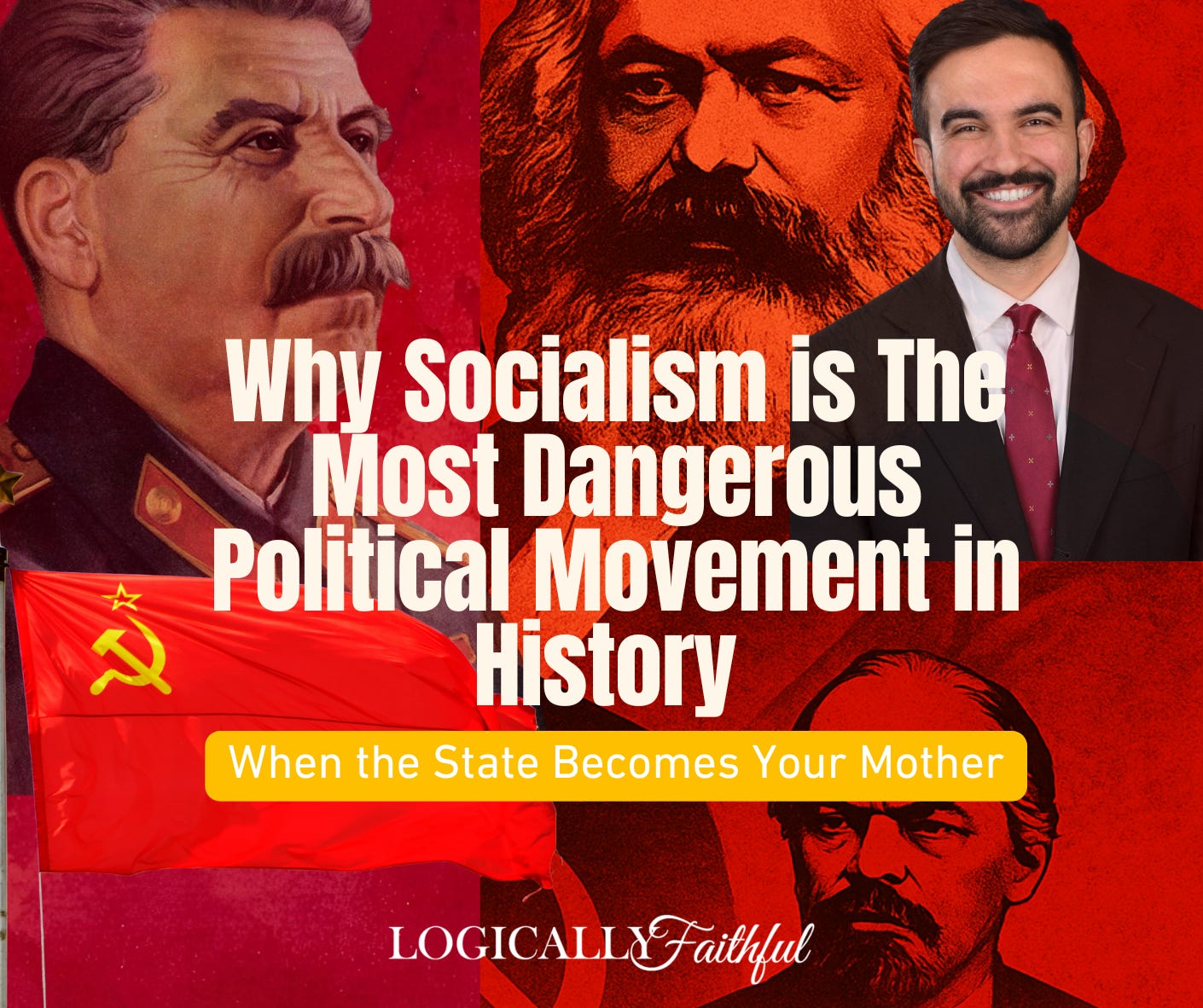
But narratives are powerful, dangerous things. Especially when they cloak ideological engines. Mamdani’s rise is not just a local political story—it is the triumph of a worldview that presents itself as compassionate softness yet demands the expanding power of the state. It is the marriage of Marxist economic theory, feminist moral instincts, and immigrant identity politics—all baptized in the language of empathy. The problem is not Mamdani the man; it is Mamdani the symbol. Because history shows us that when the state becomes your mother, and ideology becomes your theology, compassion becomes coercion, and the road to utopia is paved with bodies.At the kitchen table, a mother sees the weakest child and, instinctively, takes from the strong to feed the weak. No sane person calls that unjust. It is one of the most beautiful things in the world.
But hand that same instinct a tax code, a central bank, and an army, and you have the beginning of socialism.
In this essay, I will argue four theses:
1. Socialism grows out of a maternal moral style—high in compassion and equality—while classical liberalism and conservative economics grow more out of a paternal style—hierarchy of competence, responsibility, and earned reward. 
2. Any ideology fused with concentrated state power becomes deadly—whether Marxist atheism or state-backed Christianity. John Calvin in Geneva and Marxist dictators in Moscow share more in common than either would like to admit. 
3. Marx’s own writings drip with revenge, destruction, and godlike pride—using imagery that many commentators have noted sounds eerily Luciferian. 
4. Marxist ideas flowed into feminism, and feminist moral instincts now feed social-democratic politics, giving us a respectable, soft version of communism that—if left unchecked—tends historically to drift toward the hard version. 
⸻
1. The Real Problem: Power + Certainty
Before we talk about Marx or feminism, let’s confess something uncomfortable:
Christians have also killed in the name of truth.
Calvin and Servetus: when doctrine gets a sword
In 1553, the theologian Michael Servetus was burned at the stake in Geneva for heresy—among other things, rejecting the Trinity and infant baptism. The civil council passed the sentence, but John Calvin’s theological influence weighed heavily on the trial. 
Historians debate details—how much Calvin pushed, whether he preferred a “milder” execution—but the bottom line is chilling:
A city proud of its biblical reform
used state power to kill a man over theology.
Tyndale: executed for giving people a Bible
In 1536, William Tyndale—who translated the Bible into English—was strangled and burned after being condemned as a heretic for challenging church–state control of Scripture and doctrine. 
His “crime” was letting ordinary people read God’s Word without going through the approved gatekeepers.
These were not atheists. These were rulers claiming the name of Christ. They prove that the danger is not just Marxism; it’s any worldview wedded to too much power.
When you give fallen humans the power to punish heresy or “injustice” with the sword,
theology becomes ideology and compassion becomes control.
Keep that in your mind as we turn to Marx.
⸻
2. Marx’s Dark Hunger: Thrones, Ruins, and Revenge
Modern textbooks often present Marx as a kind of secular economist in a bad beard, muttering about class struggle and surplus value.
They rarely show you his soul.
In one early poem, “Invocation of One in Despair,” written after he abandoned Christian belief, Marx has his speaker lament:
“So a god has snatched from me my all…
Nothing but revenge is left to me.” 
The poem goes on with lines like:
“I shall build my throne high overhead,
Cold, tremendous shall its summit be.” 
Noticed that this sounds uncannily like Lucifer’s boast in Isaiah 14: “I will ascend into heaven, I will exalt my throne above the stars of God.” !
In another poem, Marx imagines a triumph after total destruction:
“Then I will be able to walk triumphantly, like a god, through the ruins of their kingdom.” 
You don’t have to believe he literally worshipped Satan to see the pattern:
• Revenge against the God who “snatched” everything from him
• A desire to build his own throne
• A fantasy of walking “like a god” through the wreckage of the existing world
Is it any shock that such a soul would dream of tearing the world down and rebuilding it by force?
Marx’s political project is not neutral economics. It is spiritual war against hierarchy and transcendence. When such a vision gets a state, it doesn’t reform; it purges.
⸻
3. When the Mother Becomes the State
Now, back to the kitchen table.
Imagine a family: three strong teenage sons and one frail, sickly daughter. Dinner is served. The sons pile meat and potatoes on their plates. The daughter sits quietly.
The mother sees all of this and says:
“No, you don’t. Give some of that to your sister.”
She redistributes. And she is right.
Now take that instinct and blow it up to national scale.
The socialist looks at billionaires and the poor and says:
• “We have exploited rich ‘sons’ and hurting ‘daughters’.”
• “The state must step in as Mother and enforce fairness.”
• “It’s not enough to have equality before the law; we must push toward equality of outcomes.”
From there, the logic is simple:
• Heavier taxes on the “strong”
• Larger programs for the “weak”
• Increasing control of industries “for the people”
Democratic socialists present this beautifully. The Democratic Socialists of America say capitalism is a system “designed by the owning class to exploit the rest of us” and call for social ownership and democratic control of the economy. 
That’s the best version of their argument. And the moral instinct is real: compassion for the weak, disgust at exploitation.
But here is the crucial point:
What is healing at a family table
becomes suffocating and often deadly when wielded by a centralized state.
The state is not your mom. It has handcuffs, courts, and guns. It cannot simply “care”; it must coerce.
⸻
4. The Feminine Tilt: Why Women Tend to Like Socialism More
This brings us to a delicate point that we must state carefully and respectfully.
Across large cultures, women consistently score higher than men on Agreeableness—the Big Five trait associated with empathy, conflict-avoidance, and caring for others.
And a significant body of political research shows:
• Women, on average, are more supportive of welfare spending and redistribution than men. 
• They are more likely to favor government social programs, especially in low-welfare environments like the U.S. 
• Young women in Western democracies are trending more left-wing than young men, deepening the ideological gender gap. 
Not every woman is a socialist. Not every man is a capitalist. But statistically, socialism resonates more with a maternal moral style—“protect the vulnerable, share the resources, no one left behind.”
In the home, that is beautiful.
In the church and voluntary charities, that’s indispensable.
In the state, if left unchecked, it becomes a machine that punishes competence and rewards dependency.
Socialism is what happens when the mother’s heart is given the police power of Caesar. It what happens when men give into this maternal instinct and abandon their patriarchal one.
⸻
5. From Marx to Feminism to Social Democracy
How did Marx’s dark vision seep into feminism and then into modern social democracy?
Marx and Engels argued that women’s oppression was rooted in their role in the family within class societies. Women in property-owning families reproduced heirs; working-class women reproduced future laborers. 
In other words: the family itself, under capitalism, is a site of oppression.
Socialist and Marxist feminism
By the late 1960s and 70s, socialist and Marxist feminism explicitly merged Marxist class analysis with women’s liberation. Academic and activist movements developed “socialist feminism” as a distinct current, blending critiques of capitalism with critiques of patriarchy. 
Second-wave feminism birthed groups like “Marxist-Feminists” and “Red Women,” explicitly linking women’s liberation to Marxist ideas. 
Even when later feminist movements softened or distanced themselves from explicit Marxism, they kept:
• The language of oppressor vs. oppressed
• The suspicion of hierarchy and tradition
• The belief that freedom requires structural revolution, not just personal morality
These frameworks flowed naturally into social democracy:
• The “patriarchal family” becomes a symbol of structural injustice.
• The market becomes a system of exploitation.
• The state becomes the chosen instrument to “level the playing field” in the name of equality and “equity.”
So the pipeline looks like this:
Marx → Marxist/Socialist Feminism → Social Democracy → “Scandinavian-Style”→ Communism.
Each step is more respectable. Each step sounds more compassionate. But the metaphysical DNA does not change:
resentment of hierarchy, suspicion of earned differences, and faith that the state can fix it all.
⸻
6. A Live Example: Zohran Mamdani and the Red–Green Alliance
Enter Zohran Mamdani, New York City’s first Muslim and South Asian mayor-elect, a self-described democratic socialist who ran on radical economic justice: rent freezes, universal childcare, $30 minimum wage, city-owned grocery stores, fare-free buses, and heavy taxes on the rich. 
He proudly declares:
“I am Muslim. I am a democratic socialist. And most damning of all, I refuse to apologize for any of this.” 
Reports describe his rise as part of a “Red–Green” alliance—a coalition between left-wing socialist movements and Muslim civic groups. 
A resurfaced video shows him talking about “seizing the means of production,” which has understandably horrified refugees who survived actual communist regimes. 
Here is the tension:
• Classic Islamic law assumes private property, marketplace trade, and strong family responsibility—not permanent state control of the economy.
• Yet Mamdani fuses Islamic identity with hard-left economic aims, presenting them as a package of compassion, justice, and anti-Trump resistance. 
I’m not questioning his sincerity. But it’s hard to escape the impression that religion has become political branding—a halo over a Marx-shaped economic project.
And that’s exactly my point: whether it’s a cross or a crescent or a rainbow on top of it, socialism underneath is still socialism.
⸻
7. “But That’s Not Real Socialism!” – Steel-Man and Response
Your social-democratic friends will say:
“We’re not Stalin. We’re not Mao. We want democracy, civil rights, and safety nets—
not gulags and secret police.”
Fair enough. Let’s steel-man them:
• They genuinely want to end poverty and exploitation.
• They are offended by obscene wealth alongside homelessness.
• They want health care, housing, and dignity for all.
• They insist on democratic control and explicit rejection of totalitarianism. 
Now the response:
1. The economic logic doesn’t change.
Democratic socialism still aims at social ownership and political management of major sectors of the economy. That necessarily means more power concentrated in fewer hands. 
2. The moral psychology doesn’t change.
It still treats most inequalities of outcome as prima facie unjust and expects the state to fix them. That’s the maternal instinct—beautiful in a family, dangerous in a bureaucracy.
3. The power problem never goes away.
The more you task the state with “caring” and “equity,” the more tools you give future ideologues—left, right, or religious—to crush dissent in the name of compassion.
And history whispers in the background:
• Christian cities burning heretics. 
• Monarchies strangling Bible translators. 
• Communist regimes starving millions in the name of equality.
Different slogans.
Same pattern: too much power, too much certainty, not enough humility.
⸻
8. A Personal Experiment: My Mini-Socialist Classroom
Let me make this concrete.
Years ago, in one of my philosophy classes, I ran a small “socialist experiment.”
My students were convinced socialism was the fairest system. “No one rich, no one poor, everyone equal,” they said.
So I told them:
“From now on, every exam grade will be averaged.
Those who study hard will share their grade with those who don’t.
No one will fail. No one can excel.”
On the first test, the hard workers were furious, the slackers delighted. They all got a comfortable B.
By the second test:
• The hard workers had stopped trying—why bother?
• The slackers were still slacking—why change?
• The class average dropped to a C.
By the third, nobody studied. Everyone got a D.
No one was rich. No one was poor. Everyone was equally miserable.
This is a tiny classroom parable of a huge civilizational truth:
If you punish excellence and reward laziness in the name of fairness,
you don’t lift up the weak;
you pull everyone down.
The maternal instinct says, “Share with your brother.”
The economic reality says, “If you take away the fruit of responsibility, you also kill the tree that feeds the family.”
⸻
9. Compassion with Limits: What We Actually Need
So what do we do with all this?
1. Honor the maternal instinct where it belongs.
In families, churches, and voluntary communities, we should take special care of the weak, carry each other’s burdens, and share sacrificially.
2. Recover the paternal virtues where they belong.
In markets, institutions, and culture, we need hierarchy of competence, accountability, risk-taking, and reward for hard work.
3. Limit the state before it becomes a god.
The state should punish real injustice, protect life and property, and create space for civil society—not micromanage every outcome “for our own good.”
Marx’s dream was not just a nicer tax bracket; it was to “walk triumphantly, like a god, through the ruins of their kingdom.” 
We do not honor the poor, the oppressed, or the victims of history—including those killed by Christian and communist regimes—by repeating that dream with a softer voice and a kinder logo.
We honor them by refusing to give any ideology—ours or anyone else’s—the throne that belongs only to God.
Conclusion
And so here is the warning, as plainly as I can utter it: when a society forgets that compassion requires discipline, that love requires limits, and that justice requires humility, it begins to worship the state as a surrogate parent—first as a gentle mother, then as a devouring god. This is the ancient story, written in blood across the ruins of every revolution that promised heaven and dragged its people into hell. You can wrap the rhetoric in progressive poetry, Islamic symbolism, feminist liberation, immigrant hope, or the soft glow of “equity,” but the iron law does not change: power without constraint becomes tyranny, and compassion unmoored from responsibility becomes cruelty. And if we refuse to learn that, if we continue to baptize envy in the language of empathy and call coercion “care,” then we will repeat the same catastrophic cycle our ancestors died trying to break. But we do not have to. We can remember that the state is not our mother, that ideology is not our savior, and that human beings—flawed, fallen, glorious, capable of staggering good and unspeakable evil—must never again be entrusted with godlike power over one another. The future will belong either to those who rediscover that truth, or to those who are crushed beneath the weight of forgetting it.
⸻