



When Monica Lewinsky entered the White House in July 1995, she was a 21-year-old intern. Bill Clinton was 49, the sitting President of the United States, at the height of his political power. By that November, their interactions moved beyond professional boundaries.
According to the official record—the Starr Report, later congressional testimony, and Clinton’s own admissions—their relationship developed privately and intermittently between 1995 and 1997. It consisted of oral sexual encounters initiated inside the White House, often in the Oval Office or adjacent rooms such as the private study.
It was a love story according to her but not to him.
It was not an affair conducted in the open.
It was a deeply asymmetrical relationship between the most powerful man in the country and the youngest, least powerful woman in the building.
Monica Lewinsky was never Clinton’s equal—socially, politically, or psychologically. She was a young staffer who, by her own account, felt flattered, overwhelmed, and emotionally attached. Clinton, by contrast, compartmentalized. He continued his public duties, safeguarded his image, and maintained a marriage while engaging privately with an intern who believed he cared for her more than events would later show.
Clinton denied the relationship repeatedly to the American public, to his staff, even under oath—famously insisting,
“I did not have sexual relations with that woman, Miss Lewinsky.”
He later admitted that statement was “misleading.”
Lewinsky was exposed, humiliated, dissected in public, stripped of privacy, dignity, and the future she had envisioned. Her name became synonymous not with a tragedy, but with a punchline. The late-night hosts feasted on her. Strangers spat her name as an insult. Her humanity was devoured by the machinery of public shame.
Clinton, meanwhile, survived. More than survived—thrived.
His approval ratings rebounded. His party rallied around him. He went on to earn over $100 million in speaking fees alone, commanding $300,000 per engagement.
The imbalance was brutal:
Clinton survived the scandal, finished his term, and became one of the highest-paid speakers in the world.
Lewinsky became a punchline—on late-night shows, in tabloids, even in school hallways.
She was subjected to global humiliation at age twenty-two.
She lost friendships, job prospects, privacy, and the possibility of living a life unknown to millions.
Yes, it was and still is a double standard. And I will argue that if it was not civilizations would collapse.
Lewinsky has lived most of her adult life alone.
No man wanted to be with her bearing a stigma that never quite washes off.
She dreamed at 21 of having 4 children and raising a family and that dream sadly died.

The lie is still here:
Women can behave sexually as freely as men without the consequence like men.
The Feminist Promise: “You Can Live Like any Man”
Second-wave feminism rightly fought for equal pay, equal opportunity, legal protection against harassment and abuse. Those gains were real and overdue.
But entwined within that project was another, less examined ambition: to dismantle the idea that female sexuality is uniquely vulnerable, uniquely consequential, uniquely in need of protection. If men could behave casually about sex, the argument went, then justice demands that women must be able to do the same and be treated the same.
The slogan was not always explicit, but it was everywhere:
“My body, my choice.”
“Slut-shaming is the problem, not slut behavior.”
“If men can do it, so can we.”
The aim sounded reasonable: equal standards. The reality, however, is that biology is not egalitarian. It is asymmetrical.
The asymmetry and double standard remains:
A man can impregnate and walk away.
A woman must bear physical, emotional, and social risk.
A man’s sexual past is seen as experience.
A woman’s sexual past is seen as evidence rightly or wrongly about her future loyalty, stability, and value.
Birth control can prevent pregnancy.
It cannot prevent:
reputational cost
emotional bonding
difficulty forming long-term attachment
the public’s cruel memory
the biological imprinting that makes female promiscuity costlier
Women still pay more. They always have.
Feminism, at its best, demanded that men shoulder more of that burden, in law and in culture. At its worst, it denied that the asymmetry existed at all.
That denial now collides head-on with the digital sexual marketplace.
OnlyFans and the New “Empowered” Shame
Consider OnlyFans, the subscription platform where creators—most of them young women—sell erotic or pornographic content directly to fans.

The numbers are revealing:
The average age of an OnlyFans creator is 27, with 55% of female creators under 30 and nearly half of new creators between 18 and 24.
The user base is overwhelmingly male: roughly 79% of users are men.
Women dominate earnings; female creators on average earn more than male creators, and media narratives fixate on outliers making millions a year.
To a certain kind of feminist and influencer, this looks like poetic justice: young women, long objectified for free, are finally cashing in. Instead of being “exploited,” they are now the exploiters selling desire back to men at a premium.
But a harsher truth lurks beneath the success OnlyFans stories.
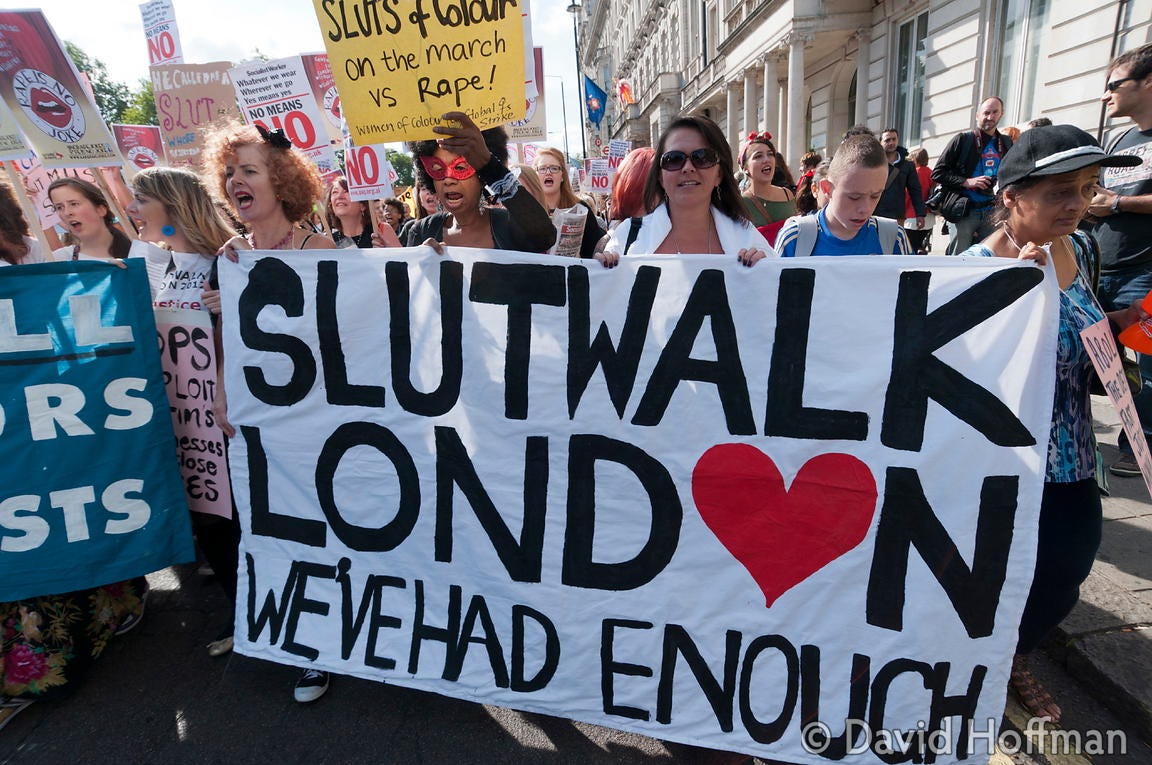
This “market power” is built almost entirely on women’s bodies as consumable spectacle.
The very thing earlier feminists condemned—reducing women to sexual objects for male pleasure has been repackaged as a side hustle!
The gaze hasn’t changed; only the revenue model has.
OnlyFans is a tip of the iceberg. Beneath it lies an ocean of more ordinary sexual content creation: sexting, self-generated nudes, hookup culture, casual pornography consumption. Research on adolescents and young adults shows that earlier sexualization and exposure to porn are associated with increased risk of viewing sexual aggression and misogynistic acts as “normal.”
This is not the profile of a generation calmly enjoying emancipated sexuality. It is the profile of a generation drowning in stimuli their nervous systems were never meant to process.
From Shame Culture to “You Do You”

When I was a boy in my village in Jordan, the girls were never unprotected. Not because they were weak, but because everyone understood a simple truth: where there is beauty and vulnerability, predatory men will appear. Fathers knew it. Brothers knew it. Even unrelated men knew it. So they watched. Quietly. Constantly. A girl walking alone was noticed. A stranger lingering too long was noticed. Protection was not control; it was moral responsibility embedded in daily life.
That protection mattered because men, left unchecked, do not become noble by default. They become opportunistic. A young woman without the visible presence of her father or brothers was not “free” she was exposed. And everyone knew it. That is why the village closed ranks around its daughters. Not to suffocate them, but to shield them from men who would take what they could and disappear.
Today, many young women live alone, far from fathers and brothers, told that dependence is weakness and that “I don’t need a man” is empowerment. But predators hear something different. They hear no witnesses, no consequences, no protectors. Independence does not abolish male nature; it simply removes the buffers that once restrained it.
This is why sexual responsibility has never been symmetrical and always a double standard.
Then we drop them into an online ecosystem where every choice is screenshotted, databased, screen-recorded, monetized, and searchable forever.
Lewinsky was destroyed by the analog version: newspapers, late-night television, congressional reports. Today’s young women live with something worse: a permanent digital record, endlessly replicable, impossible to fully erase.
We have removed the local constraints and multiplied the global exposure.
The Facts: More Freedom & More Sexual Partners=More Sadness
Look at the data, and a pattern emerges.
Early and Casual Sex and Mental Health
Attitudes toward casual sex have liberalized.
A majority of American adults now say casual sex between consenting adults is acceptable, with younger adults significantly more accepting than older generations—of course!
Yet research connecting early sexual activity to mental health outcomes is sobering:
Modern hookup culture is sold to young women as liberation, but the evidence reads more like a quiet indictment. As documented in mainstream outlets like The New York Times and The Atlantic, college women increasingly describe sex in the language of cost–benefit analysis—low investment, low risk, no attachment—yet the lived reality undermines the promise. Many admit relying on alcohol just to endure casual encounters, often prioritizing male pleasure because it is “quicker,” while research presented at the International Academy of Sex Research shows women are twice as likely to reach orgasm in committed relationships than in hookups, a disparity no slogan can erase. Even the language betrays the truth: men “pound,” women “get pounded”—pornographic metaphors that encode inequality while masquerading as freedom. Despite claims of sexual revolution, sociological data presented at the American Sociological Association shows hookup prevalence is exaggerated, not historically unprecedented, and certainly not the engine of widespread female fulfillment it is said to be. Most revealing is the moral residue that refuses to disappear: a study in the Journal of Social and Personal Relationships finds that both men and women judge promiscuous women, including promiscuous women themselves—proof that the double standard feminism promised to dismantle persists because it is rooted not merely in culture, but in psychology, embodiment, and consequence. (Boscia, Ted. “Study: Women Reject Promiscuous Female Peers as Friends.” Cornell Chronicle, 30 May 2013, news.cornell.edu/stories/2013/05/study-women-reject-promiscuous-female-peers-friends.)
As C.S. Lewis warned, ignoring moral reality does not abolish it; it abolishes us.
Or as Mark Twain might put it, the trouble is not that women were freed to live like men, but that they were freed to inherit male vices while still paying female costs.
What is marketed as empowerment increasingly resembles another arrangement in which women give more, risk more, and receive less—only now with better branding and worse outcomes (Drexler, 2014; The New York Times; The Atlantic; Journal of Social and Personal Relationships).
Yes, I know that correlation is not causation—but when the same association appears across cultures and methodologies, it is foolish to shrug it off.
Most striking is the mental health crisis among girls:
Nearly 3 in 5 U.S. teen girls (57%) reported persistent feelings of sadness or hopelessness in 2021, a figure that stayed above 50% in 2023—almost double the rate for boys.
Recent national data shows depression rates higher in females (16%) than males (10%), with the highest prevalence in adolescent girls (26.5%).
Analysts and psychologists describe this as “the largest epidemic of adolescent mental illness ever recorded,” with loneliness, self-derogation, and anxiety especially intense among young women.
Again, no reputable scholar will say, “Casual sex and OnlyFans cause depression.” Life is more complex than that. Social media, family breakdown, economic anxiety, and cultural polarization all play roles.
But we cannot ignore the alignment: as our culture tells girls their bodies are brands, their sexuality a commodity, and their boundaries “internalized patriarchy,” their mental health collapses.
The ideology says, “This is empowerment.”
The nervous system says, “This is trauma.”
Hypergamy and the Tinder Economy

Hypergamy—women’s tendency to seek partners at or above their own status—is not a moral flaw. It is a rational adaptation in a world where pregnancy was dangerous and dependence on male provision was often unavoidable. A man’s ability to earn, protect, and commit wasn’t just attractive; it was life insurance.
In the age of dating apps, this instinct collides with platform dynamics.
Dating apps expose this truth brutally:
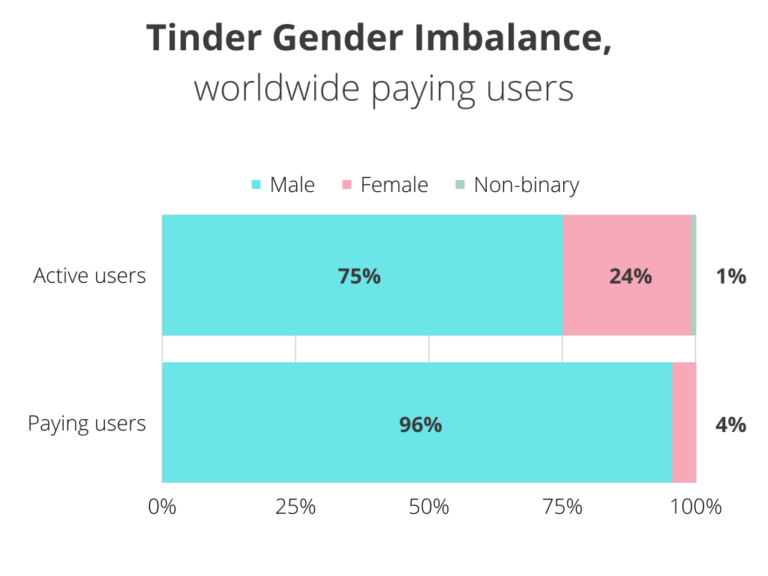
Women swipe right on ~5% of men
Men swipe right on over 70% of women
Thus:
A man with many partners signals rarity—a capable, desired man.
A woman with many partners signals “easy” and low-self worth, not achievement.
Her ability to choose is valuable.
His ability to be chosen is rare.
This is why sexual double standards persist:
Male promiscuity increases male status.
Female promiscuity decreases female status.
Not because women are worth less,
but because women risk more!
As of 2021, about 76% of U.S. Tinder users were male, 24% female.
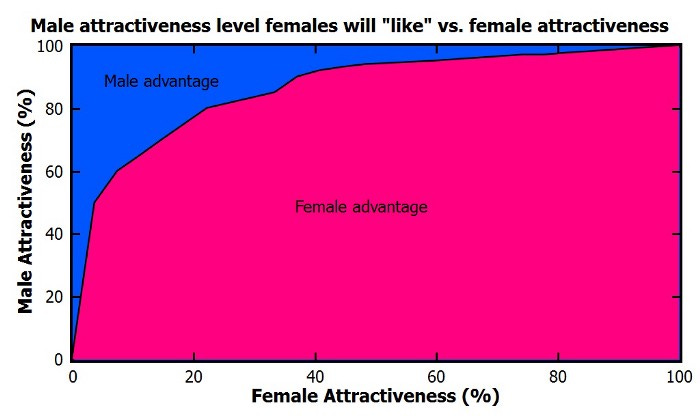
Behavior is sharply asymmetric:
Men swipe right far more often; women are far more selective. Data from millions of swipes shows women like roughly 5% of profiles they see, while men like well over half.
As a result, women enjoy match rates more than ten times higher than men—about 30.7% for women vs. 2.6% for men in one large dataset.
In other words:
Almost any young woman can access sexual attention on demand.
Very few men can.
This explains one half of the contemporary double standard:
A man with many partners signals social and sexual success; he is one of the few who can overcome female selectivity.
A woman with many partners is not signaling the same thing. Given the abundance of offers, she demonstrates not her desirability, but her willingness to say yes.
That is why promiscuity makes men appear strong but makes women appear used. Not because women are worth less—but because their ability to choose is worth more.
Hypergamy and selectivity ensure that male sexual success functions as an achievement; female sexual success functions as a default.
Feminism tried to erase that asymmetry at the level of meaning. The apps built a machine that exposes it in cold numbers.
What Feminism Forgot
Feminism was right about women suffering under horrible men with power.
It was wrong about sameness.
Men and women are equal in dignity and value.
They are not equal in sexual consequence.
Cultures that forgot this in the past punished women and men who hurt them violently.
Cultures that forget it now punish women psychologically and socially.
The Spiritual and Psychological Cost

At the deepest level, something more than sociology is at stake.
Across religious traditions, the female body is treated as a sign of mystery. The womb is not just an organ; it is an icon of creation itself. Jewish, Christian, and Islamic theology all, in different ways, cast motherhood as participation in the divine work of bringing forth new life.
You don’t have to be religious to feel a faint echo of this when you see a pregnant woman in a crowded subway car. People still instinctively stand up, still offer a seat. The body carries the future; the crowd adjusts.
A culture that told women, “Your ability to bear life makes you sacred,” also told them, “Therefore your sexuality must be honored and guarded.” Sometimes this became suffocating, even violent. But the instinct recognized a truth: female sexuality is not trivial. It is generative power.
Today, that power is often wielded in a marketplace that treats it like any other content stream. The young woman posing on OnlyFans is not being stoned by a village; she is being liked, tipped, followed, algorithmically boosted.
Yet long after the payments stop, she may still carry:
memories of encounters that were never really about her
body image distorted by constant self-surveillance
difficulty forming deep bonds with men who first knew her as a product
anxiety about what future children will find with a single search
Overlay this with the broader youth mental health crisis—where girls report record levels of sadness, self-harm, and depression —and it is hard to argue that this is liberation.
What looks like power often feels like hollowness.
Toward an Ethic That Tells Women the Truth
If we strip away nostalgia and ideology, what remains is something like this:
Men and women are equal in value and equal in moral agency.
But Male and female sexuality are not equal. And no they are not interchangeable.
Cultures that ignored this in the past punished women violently; cultures that ignore it now punish women psychologically.
We cannot go back to honor killings and forced marriages.
We should not cling to the hypocrisy that let powerful men sin while crucifying women.
But we also cannot build a humane society on the lie that a woman can live sexually like a man and emerge equally unscathed.
A saner ethic would:
Tell girls the truth about their power: that their bodies are not billboards but sanctuaries.
Tell boys the truth about their duty: that their masculinity is proven not by conquest, but by restraint and protection.
Tell boys that good men protect women from bad men.
Treat sex as a binding act, not a recreational one.
Treat pornography as a public health problem, especially for developing minds.
Challenge the economic structures that profit from sexualizing increasingly younger bodies.
Recover a sense of honor that is not about killing the girl who fell, but about raising the standard for the men who pushed her.
Monica Lewinsky’s life is a cautionary tale about what happens when a young woman’s sexual mistake collides with power, patriarchy, and a hungry media machine.
The OnlyFans generation is a cautionary tale about what happens when a young woman’s sexuality collides with algorithms, marketplaces, and a feminism that forgot her soul.
In both cases, civilization sends the same quiet message:
“You, woman, are more precious, and can hold something inside you more valuable than all the world.
When you fall, the ground shakes more.
The task now is not to deny that message, nor to resign ourselves to its cruelest expressions, but to build a sexual ethic honest enough to acknowledge the asymmetry—and compassionate enough to protect the ones who bear it in their bodies.
We owe young women more than slogans.
We owe them the truth.
CONCLUSION
What we have traced here is the arc of a devastating contradiction: a culture that screams “men and women are the same,” while punishing women far more harshly for the very sexual behaviors it encourages them to imitate. Monica Lewinsky learned that truth the brutal way—one young woman destroyed for a private encounter with the most powerful man on earth, while he walked away richer, more beloved, and more powerful than before. Forty years later, the same culture applauds millions of young women who broadcast their sexuality publicly and calls it empowerment. But the consequences still land on women first and hardest: rising depression, collapsed bonding capacity, emotional devastation, the permanence of digital exposure, and the quiet, corrosive loneliness of being consumed by thousands of strangers but known by none. The lie that “women can live like men” sexually has not liberated them—it has wounded them. Female sexuality has always carried more weight—biologically, socially, psychologically, civilizationally—because they bear more and are more impacted by trauma because they were made to be protected not become protectors themselves.
Biology loads the dice against women sexually. Reality demands responsible sexual choices from women more than men. Civilization depends on it.
And any ideology that ignores these truths is not offering freedom—it is offering a cliff.
And I say this not as a theorist, but as a father. I have a young, beautiful daughter whose future is more precious to me than my own breath, and I refuse to let a dying culture tell her that her worth is in her sexual availability, her visibility, or her independence from family, motherhood, and love.
I want her to know what every young woman deserves to hear: that she is sacred, that her sexuality is powerful and consequential, that her longing for commitment and children is not weakness but wisdom, and that she carries a deeper strength than any algorithm or ideology can comprehend. She bears more because she carries more and she is not meant to carry it alone.
And if she honors that truth—God’s truth, if any young woman honors that truth—her life will be built not on the empty lie of “live your life,” “have fun!!” but on the solid foundation of meaning, belonging, covenant, identity, and legacy.
That is hope. That is life. And that is the truth every daughter deserves to inherit.