


When I started dating her, everyone warned me.
Her parents warned me.
Her relatives warned me.
My own parents warned me.
I had multiple independent lines of evidence telling me that that relationship was not right for me—and that I was not right for her. The warning signs were not subtle. They were consistent, convergent, and persistent.
I ignored every single one. And I was working on my PhD!
I didn’t just ignore them—I reinterpreted them. Each red flag became a misunderstanding, a challenge to overcome, or proof that others simply “didn’t see what I saw.” I believed my insight was deeper, my love purer, my reasoning superior.
That decision cost me more than I can fully articulate—financially, physically, spiritually. It even cost me my family.
Years later, in a completely different setting, the same question returned—this time in institutional form.
At my college, a new dean was installed. She was brilliant: degrees, publications, wit, experience. Smarter than most of us by conventional measures. And yet, within a short period, she alienated the faculty, the staff, and eventually even her own administration.
She micromanaged, bypassed established procedures, followed the letter of the law while ignoring its spirit, and became convinced that ignorance was defiance.
She ultimately lost her job.
Again, the same unsettling question emerged:
Why do “smart” people do stupid things?
That question is the heartbeat of what I now think of as the stupidity paradox—the deeply counterintuitive reality that more intelligence and more information do not necessarily make us wiser.
In many cases, they make us more blind.
Mo Gawdat and the Intelligence That Betrays Us

Few contemporary thinkers articulate the stupidity paradox more clearly—or more painfully—than Mo Gawdat, former Chief Business Officer at Google X and author of Solve for Happy and That Little Voice in Your Head. What gives Gawdat moral authority is not merely his intellect or credentials, but the crucible through which his thinking was refined: the sudden death of his son.
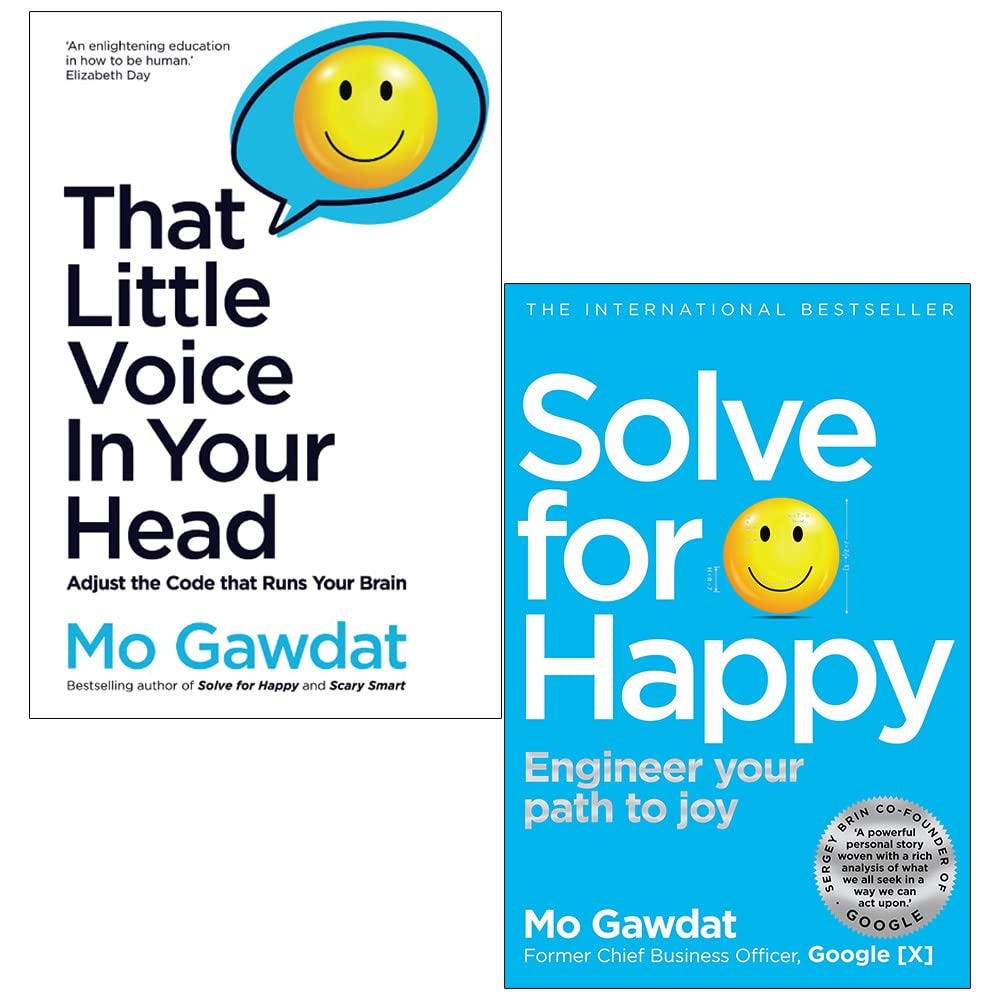
Gawdat often begins with a disarming confession. For most of his life, he believed intelligence could solve anything. As he has said repeatedly:
“I was extremely smart. I worked at Google. I optimized systems for a living. And yet I was deeply unhappy.”
That frank and rare admission that I admire, is the seed of everything that follows.
Gawdat insists that the human mind is not a neutral truth-seeking machine. It is a self-protective narrative generator. Or, as he puts it bluntly:
“Your brain’s job is to keep you alive—not to make you happy, and certainly not to make you right.”
This insight lands squarely at the heart of the stupidity paradox. The more intelligent we are, the more elaborate our self-deceptions become. We do not merely resist reality—we out-argue it.
One of Gawdat’s most enduring contributions is his simple but devastating equation:
“Suffering = Pain X Resistance.”
Pain, he explains, is unavoidable. Resistance is the refusal to accept reality as it is. And intelligence often magnifies resistance, because smart people are better at inventing reasons why reality must be wrong.
Reality, he says, does not negotiate. It does not care how intelligent you are. It simply is. The tragedy is that the mind prefers comforting stories to uncomfortable truths. As Gawdat memorably observes:
“The mind will always choose a familiar lie over an unfamiliar truth—because familiarity feels safe.”
Here, Gawdat converges almost perfectly with the psychological research David Robson documents in The Intelligence Trap: Why Smart People Make Dumb Mistakes by David Robson (W.W. Norton, 2019) This is what psychologists call confirmation bias, Gawdat calls ego-protection. We do not evaluate beliefs impartially; we defend identities.
Robson’s central claim is not that intelligence is bad. It is that intelligence, when unmoored from wisdom and humility, often becomes a liability. Drawing on peer-reviewed research in psychology and neuroscience, he documents how highly intelligent people are often better at rationalizing bad beliefs than ordinary people—not worse.
Technology, in Gawdat’s view, has supercharged this weakness. Algorithms do not reward humility; they reward certainty. They do not amplify truth; they amplify emotion. As he warns:
“The problem with the modern world is not that information is wrong—it’s that it’s incomplete, amplified, and consumed without wisdom.”
Again and again, Gawdat emphasizes that intelligence without humility becomes dangerous—not just personally, but culturally. He puts it starkly:
“The biggest mistake intelligent people make is believing they are immune to mistakes.”
This is why brilliant individuals can destroy their marriages, their careers, their children, and their inner lives. It is why intelligent institutions can promote obvious falsehoods. It is why societies with unprecedented access to information can lose their grip on basic truths.
Gawdat’s most haunting insight may also be his simplest:
“The problem is not that we don’t know enough. The problem is that we think we know.”
That sentence alone captures the stupidity paradox.
Gawdat does not argue for ignorance. He argues for submission to reality. For replacing arrogance with acceptance. For trading cleverness for wisdom. In that sense, Gawdat and Robson arrive at the same warning from different roads—one through data, the other through grief:
Intelligence is a tool.
Wisdom is a posture.
And without humility, intelligence becomes self-destructive.
When Intelligence Becomes a Liability
History confirms this pattern.
A Nobel Prize–winning scientist, Kary Mullis, believed he was abducted by a glowing alien raccoon. Yes, that’s Rocket from Guardians of the Galaxy type, but glowing!
Arthur Conan Doyle, creator of the hyper-rational Sherlock Holmes, believed passionately in necromancy and fairies—yes, the Peter Pan kind! He publicly defended photographs that later turned out to be cardboard cutouts staged by children.
Albert Einstein, one of the greatest minds in history, believed socialism—particularly as practiced in the Soviet Union—would work as a political and economic system even though it is the only ideology that has killed more people than any other in the history of the world.
These were not unintelligent people. They were exceptionally intelligent. And yet they believed things that collapse under even modest scrutiny.
Why?
Your Confirmation Bias: The Engine of the Stupidity Paradox
One of Robson’s most powerful explanations is confirmation bias (also called myside bias): the tendency to seek out, interpret, and remember information in ways that confirm what we already believe—while discounting or dismissing contrary evidence.
The paradox is this: the smarter you are, the better you become at defending your beliefs, not testing them.
We mistake cleverness for truth-tracking. We confuse eloquence with accuracy. We mistake speed for insight. Intelligence gives us sharper tools—but it does not tell us when to stop using them.
This is why intelligent people can be especially vulnerable to pseudoscience, conspiracy theories, ideological possession, and social contagion. Robson cites experiments—including work by neuroscientists at the University of Chicago’s Center for Practical Wisdom—showing that reflective humility, not raw intelligence, is the strongest predictor of good judgment.
When More Information Makes Us Dumber
Here is a simple experiment: as a liberal politician today is asked, “Can men get pregnant?”
For roughly six thousand years of recorded human history, the answer was obvious. Today, some of the most “intelligent” institutions in the world—armed with data, algorithms, and “experts,” insist the answer is complex or unsettled.
Of course this politician gives an “it’s complicated” answer because he or she is not answering a biological question but managing social, legal, and reputational risk and political risk. Biologically, pregnancy is straightforward: it requires female reproductive anatomy, and biological males cannot become pregnant.
When societies abandon clear thinking in the name of compassion, even intelligent people can end up doing profoundly unwise things. The danger is not ignorance but confused wisdom—the refusal to distinguish empathy from truth. Children, especially those struggling with identity, require clarity, patience, and protection, not institutional ambiguity that treats biological reality as negotiable.
Yet when political, social, and educational systems replace plain facts with “it’s complicated” or “I’m not a biologist,” answers to straightforward questions, intelligence becomes a liability rather than a safeguard. Smart people begin managing reputations instead of reality, feelings instead of facts, and risk avoidance instead of moral responsibility. Wisdom is not merely knowing more; it is knowing what must not be obscured—especially when irreversible consequences are placed on those least capable of consenting to them. This is not a failure of information—we have way too much of it. It is a failure of wisdom.
The stupidity paradox emerges precisely here: when information multiplies faster than judgment, when confidence outpaces restraint, and when social approval and pressure replaces truth as the primary metric.
Intelligence vs. Wisdom
There is a crucial distinction we have forgotten:
Intelligence is knowing the weather forecast.
Wisdom is bringing an umbrella.
Smart people are often excellent at collecting data, spotting patterns, and generating explanations. They are not necessarily good at applying that knowledge well—especially when our pride enters the picture.
And pride is the accelerant.
Across the ancient, medieval, and modern worlds, philosophers consistently warned that intelligence and wisdom are not the same—and that confusing them is how civilizations unravel.
For Plato, intelligence (dianoia) could skillfully calculate means, but only wisdom (sophia) could see the Good toward which those means should be directed; a clever mind without ordered love, he argued, merely sharpens the tools of self-deception. Aristotle sharpened the distinction further: intelligence (nous) apprehends facts, but practical wisdom (phronesis) governs action, restraining impulse and ambition with moral vision. Without wisdom, brilliance becomes recklessness. Medieval thinkers like Augustine and Aquinas saw the danger even more starkly: intelligence severed from truth and humility inflates the will, producing what Augustine called superbia, the pride that mistakes power for righteousness; wisdom, by contrast, begins in rightly ordered loves and submission to reality as it is, not as we wish it to be.
Modernity, from Descartes onward, elevated intelligence, method, calculation, efficiency while quietly sidelining wisdom, which cannot be reduced to technique; as a result, we became extraordinarily capable and increasingly blind.
Intelligence asks, “Can this be done?”
Wisdom asks, “Should it be done, and at what cost?”
When intelligence governs alone, it accelerates error with confidence; when wisdom leads, intelligence becomes a servant of truth, restraint, and human flourishing.
Pride: The Hidden Root of Your Stupidity
By pride, I do not mean healthy confidence or satisfaction in achievement. I mean hubris—an inordinate esteem for one’s own excellence that blinds us to correction and disposes us to look down on others.
The ancients understood this long before modern psychology.
In The Odyssey, Odysseus’s pride keeps him wandering for ten years.
The ancient book of Provers warns bluntly: “Pride goes before destruction” (Proverbs 16:18).
Isaiah describes the fall of the Morning Star—traditionally understood as Lucifer—not as an intellectual failure, but a moral one: “I will make myself like the Most High.”
Pride is not loud. It is systemic, pervasive, and clandestine. It moves inside us like a virus, disguising itself as insight, courage, and moral clarity.
It was pride that led Adam and Eve to believe they could determine good and evil all on their own. It is the oldest lie in history, reducible to one sentence:
“I will not be told what to do!”
A Hard Personal Conclusion
I wish I could say I’ve learned this lesson permanently. I haven’t.
Without a community of accountability, humility, love, and correction, I am capable of repeating the same mistakes—armed with better arguments, more information, and greater confidence.
That is the stupidity paradox.
More information does not save us.
More intelligence does not protect us.
Only wisdom—slow, humble, and accountable—does.
What do you think? Where might your intelligence be making you blind?