


If God told you to do something evil… would it would do it?
It sounds like a strange question. Almost offensive. But if God commanded it, would it not become good? Yet this is precisely the problem one of the greatest philosophers in history forced religion to confront.
In 2001, a woman in Texas named Andrea Yates drowned her five children in a bathtub.
She later told the court that she believed God wanted her to do it.
Years earlier, in 1978, Jim Jones, the leader of the Peoples Temple, convinced more than 900 followers to commit mass suicide in Guyana. He presented the act as a kind of sacred obedience.
And in modern terrorism trials, perpetrators have repeatedly claimed that God commanded them to kill the innocent.
These examples are horrifying. But they raise a philosophical question that is far older than any of them:
If someone says God commanded something evil… would it become good?
This is not merely a psychological question about fanaticism.
It is a philosophical problem that has haunted theology for more than 2,400 years.
The problem was first clearly articulated by Plato.
Around 399 BC, outside a courthouse in Athens, Socrates asked a man named Euthyphro a question so simple—and so devastating—that philosophers are still wrestling with it today.
The question was this:
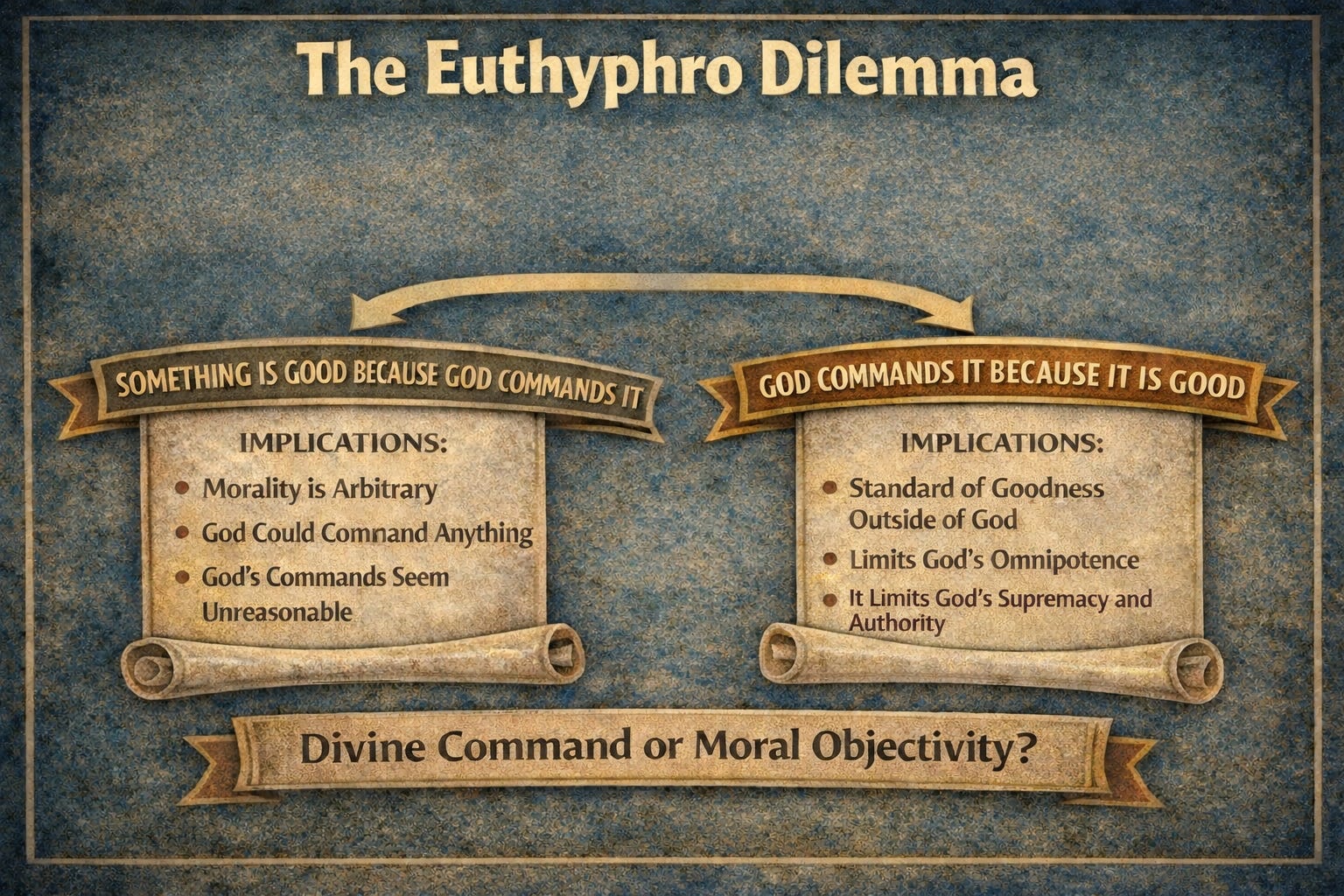
Is something good because God commands it?
Or does God command it because it is good?
That question became known as the Euthyphro dilemma, and it sits at the heart of one of the most important debates in philosophy: Where does morality come from?
The Conversation That Started It All
In Plato’s dialogue Euthyphro, Socrates presses Euthyphro to explain what holiness really is.
Their exchange goes like this:
Socrates: And what do you say of piety, Euthyphro? Is it loved by the gods because it is pious, or is it pious because it is loved by the gods?
Euthyphro: It is loved because it is pious.
Socrates: Then it is loved because it is holy—not holy because it is loved?
With that one question, Socrates exposed a deep tension.
If something is holy because the gods love it, then morality looks arbitrary. The gods could love cruelty or injustice, and those things would suddenly become good.
But if the gods love something because it is already holy, then holiness exists independently of the gods.
In other words, the gods would not be the source of morality.
This is why philosophers have called it the most dangerous question in theology.
Bertrand Russell’s Famous Criticism
The twentieth-century philosopher Bertrand Russell used the dilemma to attack religious morality.
In Why I Am Not a Christian, he wrote:
“If you are quite sure there is a difference between right and wrong, you are then in this situation: Is that difference due to God’s fiat or is it not? If it is due to God’s fiat, then for God Himself there is no difference between right and wrong.”
Russell believed the dilemma destroyed the idea that God could ground morality.
Either morality is arbitrary.
Or morality exists without God.
Game over.
But Russell’s argument rests on a hidden assumption:
that those two options are the only possibilities.
They aren’t.
The Third Option Most People Miss
Classical Christian philosophers rejected both horns of the dilemma.
Thinkers like Thomas Aquinas argued that goodness is neither arbitrary nor independent of God.
Instead, morality is grounded in God’s nature.
God does not invent goodness by command.
And goodness does not exist outside Him.
Rather, goodness flows necessarily from who God is.
God commands love, justice, and mercy because His nature is perfectly loving, just, and merciful.
This means God cannot command cruelty—not because His power is limited, but because cruelty contradicts His own character.
Just as a perfectly honest person cannot lie without ceasing to be honest, God cannot command evil without ceasing to be God.
A Simple Analogy
Imagine a perfectly designed clock.
Now ask:

Is the time correct because the clock says so?
Or does the clock say the time because some external standard determines it?
Neither answer is quite right.
The clock tells the correct time because of its internal mechanism.
Its design ensures accuracy.
Morality works the same way in classical theism.
Goodness is not arbitrary.
And it is not independent of God.
It flows from the perfect moral nature of God Himself.
Kreeft’s Famous Analogy
Philosopher Peter Kreeft often explains this using an analogy similar to this:
Asking whether something is good because God wills it, or whether God wills it because it is good, is like asking whether Shakespeare wrote great plays because he followed the rules of English grammar, or whether English grammar is correct because Shakespeare used it.
The answer is neither.
Shakespeare embodies the standard of great English usage in literature. His writing does not arbitrarily create grammar, but neither is he merely obeying rules external to his genius.
Similarly, according to Kreeft:
God is the living standard of goodness.
In several of his apologetics works (especially Handbook of Christian Apologetics, co-written with Ronald K. Tacelli), Kreeft writes something very close to this:
“Goodness is neither external to God nor arbitrary. Goodness is rooted in the eternal nature of God.”
Thus:
• God cannot command evil
• Not because His power is limited
• But because evil contradicts His own nature
Just as a perfectly honest person cannot lie without ceasing to be honest, God cannot command injustice without ceasing to be God.
Abraham, Isaac, and the Fear of Arbitrary Divine Commands
For many readers, the most troubling biblical story connected to this question appears in Genesis 22.
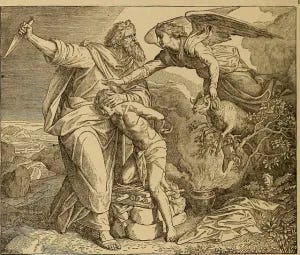
God commands Abraham to sacrifice his son Isaac.
At first glance, the story seems to reinforce the worst fears raised by the Euthyphro dilemma. If morality is simply whatever God commands, then even something as horrifying as child sacrifice could become morally right merely because God said so.
This concern has troubled readers for centuries.
Yet the biblical narrative itself pushes against precisely that interpretation.
First, the story is framed as a test, not a moral law. Genesis 22 begins with a crucial line: “God tested Abraham.” The text signals that this is not the establishment of a general moral rule but a unique moment in Abraham’s covenantal relationship with God.
Second, the command is never completed. At the decisive moment, God stops Abraham and provides a ram as a substitute sacrifice. The narrative moves away from human sacrifice and toward substitution—a theme that runs throughout the biblical story and culminates in later Christian theology.
Third, the broader moral context of the Old Testament consistently condemns child sacrifice. In passages such as Jeremiah 19:5 and Deuteronomy 12:31, the practice is described as something God “did not command, nor did it enter my mind.” The Abraham narrative therefore cannot be read as a divine endorsement of such acts.
Philosophically, this matters. If God’s commands were morally arbitrary, then the story of Abraham could easily be used to justify cruelty in the name of obedience. But the biblical narrative itself prevents that interpretation by situating the event within the larger moral character of God.
This is precisely the point emphasized by classical Christian thinkers. God does not command goodness by sheer decree. Rather, His commands flow from His nature.
In the Abraham story, the test reveals Abraham’s trust in God’s character. The author of Hebrews later interprets the event through this lens, suggesting that Abraham believed God could even raise Isaac from the dead (Hebrews 11:19). In other words, Abraham’s obedience was not blind submission to arbitrary power but confidence in the goodness and faithfulness of God.
The Danish philosopher Søren Kierkegaard famously wrestled with this story in Fear and Trembling. Kierkegaard called Abraham a “knight of faith” because he trusted God beyond ordinary ethical reasoning. Yet Kierkegaard also recognized the paradox: if every person claimed such divine authority, morality would collapse.
That tension highlights the deeper philosophical issue. The story of Abraham does not resolve the Euthyphro dilemma by embracing arbitrariness. Instead, it points toward a deeper truth: God’s commands must ultimately be understood in light of God’s character.
From the perspective of classical theism, God cannot command evil because His nature is perfectly good. Justice, love, and mercy are not external rules imposed on God; they are expressions of who He is.
Thus the Abraham narrative does not show morality being overridden by divine whim. Rather, it illustrates a moment in which human understanding struggles to grasp the purposes of a God whose character ultimately defines the moral order itself.
The story ends not with the death of Isaac but with a reaffirmation of God’s covenant promise. The ram in the thicket becomes a powerful symbol of substitution and redemption—foreshadowing themes that echo throughout the biblical narrative.
In the end, the Abraham story reminds us that the deepest question raised by the Euthyphro dilemma is not simply philosophical but theological:
If goodness is real, where does it ultimately come from?
For the biblical tradition, the answer is not a moral law floating somewhere above God, nor a set of arbitrary commands imposed by divine power.
The answer is God Himself.
Why This Question Still Matters
The Euthyphro dilemma is not just a philosophical puzzle.
It forces us to ask a deeper question:
Is morality ultimately grounded in anything real?
If morality is just human opinion, then justice and cruelty are merely social preferences.
But if moral truths are real—if torturing children is objectively wrong—then something must explain that moral reality.
For many philosophers, the most coherent explanation is that morality ultimately rests in the character of a perfectly good being.
Which means the question Socrates asked outside a courthouse 2,400 years ago still echoes today.
Not because it destroys faith.
But because it forces us to think carefully about something we often assume without reflection:
What is the ultimate source of the good itself?