


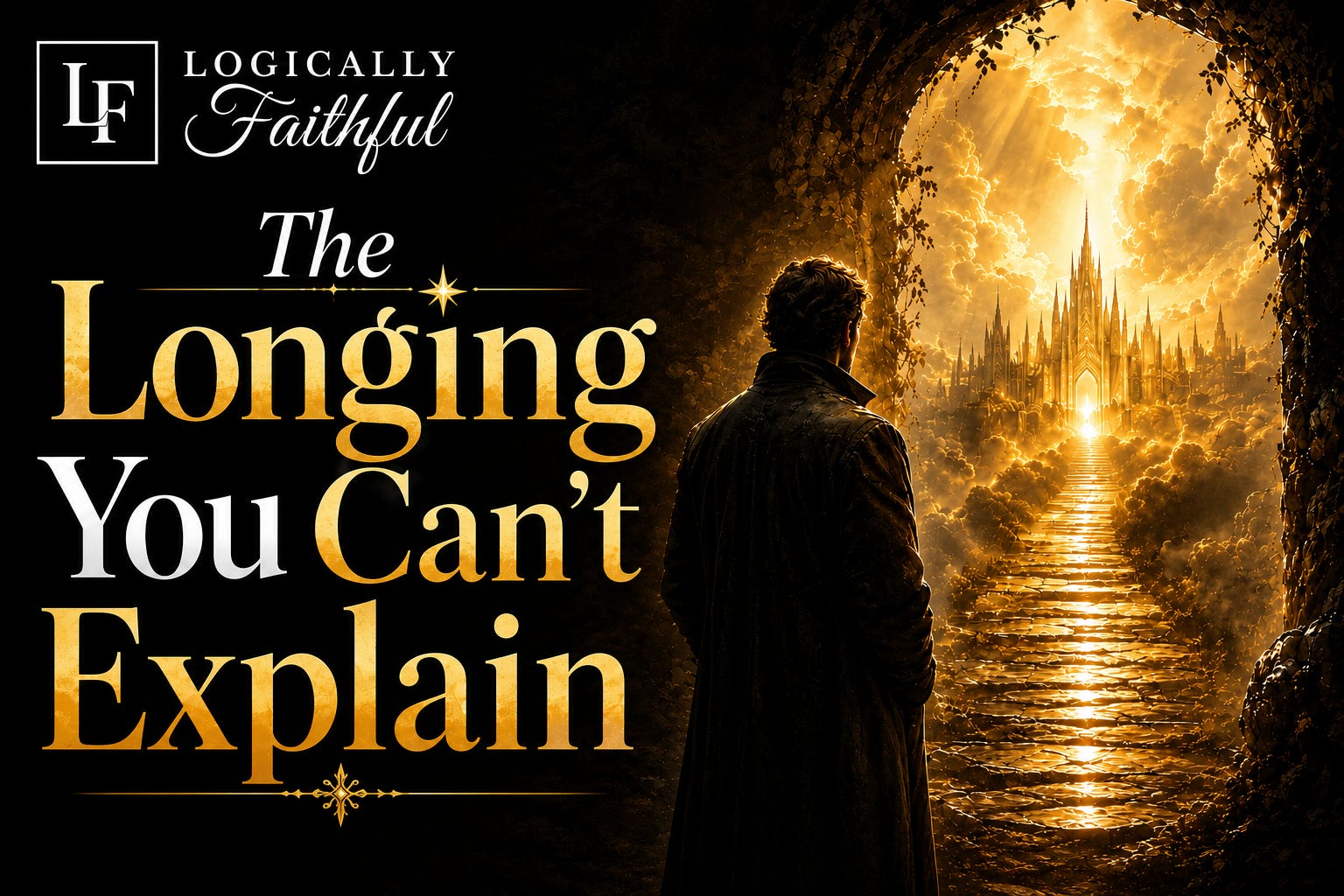
The Secret Signature of Heaven
There are some sentences that do not merely inform you. They find you.
C.S. Lewis’s line about heaven being “the secret signature of each soul” is one of those sentences. It does not feel like a tidy doctrine. It feels like recognition. Like someone finally putting words to a sorrow, a longing, a homesickness you have felt for years but could never quite explain.
Because if we are honest, most of us know this ache.
We have all had moments when life felt almost radiant enough to satisfy us, and yet somehow did not.
You get the degree.
You get the job.
You stand in the city you once dreamed of visiting.
You fall in love.
You hear a piece of music that seems to open a chamber in the soul you did not know was there.
You sit in a church as the light falls through stained glass.
You smell old books, rain on stone, incense in the air, bread in the kitchen, and for one unbearable moment, the world feels charged with meaning.
And then it passes.
That passing is painful because it was good enough to awaken desire and not good enough to complete it.
This is one of Lewis’s deepest insights.
He saw that human life is haunted by a longing that no created thing can finally satisfy. Not because creation is empty, but because creation is too small to bear the full weight of what the human heart wants. Lewis called this joy, though not in the shallow modern sense of cheerfulness. He meant something more piercing, more beautiful, and more terrible: an unsatisfied desire more desirable than any satisfaction this world can give.
And what if that is not a defect in us?
What if it is a clue?
Lewis’s famous line still startles because of its simplicity: if he found in himself a desire which no experience in this world could satisfy, the most probable explanation was that he was made for another world.
That line is not escapism. It is metaphysical honesty.
It means the soul may be structured for transcendence in the same way the eye is structured for light and the lungs for air. Hunger is not proof that food exists on your plate, but it is evidence that you are the kind of being meant for nourishment. Thirst does not magically produce water, but it reveals the sort of creature you are. And perhaps this mysterious homesickness of the human spirit reveals that we were not made merely to survive, consume, perform, and die, but to arrive.
Augustine understood this long before Lewis. “Our hearts are restless until they rest in You.” That may be one of the greatest sentences ever written because it says, in one stroke, what modern psychology often circles without naming. We are restless. Not merely busy. Not merely distracted. Restless. There is in us a movement, an ache, a dissatisfaction that cannot be cured by comfort alone. We try to medicate it with love, sex, money, success, applause, novelty, ideology, travel, and noise. But the restlessness remains because the problem is deeper than stimulation. The soul is not bored. It is exiled.
Pascal says something similar, but with even more existential force. He speaks of the “infinite abyss” within man that can be filled only by God. That image is devastating. We are not mildly incomplete creatures needing a few upgrades. We are abyss-shaped beings trying to fill an infinite hunger with finite fragments. No wonder our idols break. No wonder our pleasures fatigue. No wonder our victories sometimes feel strangely hollow just minutes after we achieve them.
This is why the modern person is so often both overfed and starving.
We have more access to comfort than most emperors ever dreamed of. We can summon entertainment instantly, food immediately, distraction endlessly. We carry little glowing altars in our pockets and consult them hundreds of times a day for affirmation, novelty, outrage, and relief. And still, at night, in silence, many of us feel it: the ache. The old ache. The thing beneath all the other things.
Lewis helps us see that this ache is not merely personal sadness. It is ontological. It belongs to what it means to be human.
And that is why his vision of heaven is so breathtaking.
For many modern people, heaven sounds thin and impersonal. A religious cliche. An afterlife brochure. Clouds, vague brightness, pious smiles, and the quiet suspicion that all strong individuality gets bleached out in the process. We fear heaven because we secretly think union with God must mean the loss of self.
But Lewis turns that fear inside out.
He suggests that heaven is not the erasure of the self but its fulfillment. We do not become less ourselves in God’s presence. We become more ourselves than we have ever been. The self is not threatened by divine light any more than a mirror is threatened by reflection. A mirror in darkness remains a mirror, yes, but only when flooded with light does it become what it was made to be.
That is one of the most beautiful things about Lewis’s phrase. Heaven is “the secret signature of each soul.” Not because we are each sovereign little gods, but because God’s love is more personal than we imagine. More exacting. More intimate. More particular. The deepest truth about you is not that you are one interchangeable specimen among billions. It is that your soul has a shape, and that shape was made for God.
Think of a lock and key.
A lock is not insulted by the key that fits it. It is fulfilled by it. The key does not destroy the lock’s uniqueness. It reveals why that uniqueness existed in the first place.
Or think of an instrument.
A violin sitting in silence is still a violin. But until it is touched by the hand of a musician, something in it remains unopened. The musician does not erase the instrument. He draws out what was hidden within it all along.
This is what sin so often obscures. We imagine sin makes us more ourselves because it feels like self-assertion. But in reality sin makes us narrower, pettier, more repetitive, more trapped in the cramped little room of ego. It does not enlarge the self. It imprisons it. Hell, then, is not merely punishment from the outside. It is the final triumph of self-enclosure, the soul locked in on itself, unable and unwilling to be drawn into the light.
Which means heaven is the opposite.
Heaven is not bland reward. It is liberation.
It is the self drawn out of its darkness.
The clenched fist opened.
The false self stripped away.
The masks burned off.
The compulsions quieted.
The scattered fragments gathered into one whole.
Kierkegaard said, “Purity of heart is to will one thing.” What if heaven is, among other things, the end of dividedness? The end of wanting God and vanity at the same time. The end of loving truth while clinging to illusion. The end of desiring holiness while bargaining for one private sin. The human soul on earth is often a civil war. Heaven is peace, not because desire is extinguished, but because desire is healed.
That is why the most beautiful earthly experiences carry sadness inside them. A sunset can make you ache. A song can make you homesick for a place you have never seen. A conversation can feel too meaningful for the smallness of time. A face can pierce you with both joy and grief at once. These moments are not meaningless. They are painful precisely because they awaken something too large to be held by the moment itself.
They are appetizers that make you hungrier.
They are road signs, not destinations. Sacraments of absence. Beautiful because they are real, but unbearable because they are partial.
Lewis saw that our earthly loves and joys are not random, but threaded together by a deeper logic. The books that move us, the landscapes that undo us, the melodies that shatter us, the memories that cling to us for years, all may be bound together by some hidden affinity. They are not heaven itself, but they are echoes of it. They are fragments of a language we once knew more fluently than we do now.
And that is why this matters so much existentially.
Because one of the great modern fears is not just that we will suffer, but that our suffering, longing, and loves mean nothing. We fear that our deepest intuitions are sentimental accidents. That the tears that come when the choir sings, or when we stand before beauty, or when we remember the dead, are just neurochemical weather passing through a doomed organism.
Lewis refuses that reduction.
He says, in effect: no, these things are not final proofs, but neither are they nonsense. They are signs. Signatures. Hints. Traces left on the soul by the country for which it was made.
And perhaps that is why no earthly success can save us.
Wanting success is not evil.
Wanting love is not evil.
Wanting beauty is not evil.
But none of them were meant to be God.
Every earthly good becomes cruel when asked to be ultimate. The weight is too much. Romance bends under it. Career bends under it. Family bends under it. Even noble work bends under it. The finite cannot carry the infinite.
But that does not make earthly things worthless. It makes them luminous.
They matter, not because they are the end, but because they point beyond themselves. They awaken us. They tutor our desire. They remind us that whatever this world is, however glorious, broken, and charged with beauty it may be, it is not the whole story.
That is the secret signature of heaven.
Buried in the soul is a shape no earthly thing can fill.
A wound no created pleasure can close.
A longing that is not madness, but memory.
Not proof that life is empty, but proof that it is unfinished.
And if Lewis, Augustine, Pascal, and Kierkegaard are right, then one day this ache will not merely be explained.
It will be answered.
One day the sign and the fulfillment will meet.
One day the hunger will become feast.
One day the homesickness will end.
One day the soul will no longer reach through shadows toward what it cannot touch.
And on that day, we will not become less ourselves.
We will become, perhaps for the first time, fully real.