


There was a time when I lived by this slogan, even if I never said it out loud. I told myself I was being loving, patient, sacrificial. But what I was actually doing was slowly abandoning my purpose. I deferred decisions. I softened convictions. I chose emotional peace over clarity. Not once, but repeatedly, quietly. I avoided tension, I avoided hard conversations believing I was preserving the relationship. In reality, I was dissolving the very structure that could sustain it.
And over time, I felt it.
I became less grounded, less decisive, less certain of who I was. I was present, but not leading. I was agreeable, but not anchored. And she felt it too. Because when a man no longer stands on anything, there is no one left to stand with him. I did not lose the relationship in a single argument. I lost it in a thousand small concessions, each one a step away from purpose.
That is how I destroyed my life.
And this is how you can avoid destroying yours
⸻
The Structural Breakdown
This is not merely psychological, it is structural.
1. If a man has no purpose, he cannot lead.
2. If he cannot lead, he cannot lead her.
3. If he cannot lead her, she cannot follow.
4. If she cannot follow, she cannot respect him.
5. If she does not respect him, he will not respect himself.
At that point, the relationship is no longer alive in any meaningful sense.
It may continue outwardly, but internally, it has already died.
⸻
Let me be clear. A woman’s or wife’s happiness does matter. It matters profoundly. Any man who dismisses that is not leading; he is failing. But our modern culture has twisted this truth into a subtle lie: that her happiness is the center, the standard, the measure of the relationship and the man must fund that and dance to her music.
That distortion, often fueled by a narcissistic strain within contemporary feminism, quietly trains men to abandon purpose in order to manage emotions.
But the opposite error is just as destructive, the older patriarchal model where only his goals, his ambitions, and his voice matter, reducing her to a NPC character in his life. That is tragic and gave birth to many forms of contemporary feminism.
Both are failures of order.
Both collapse the structure of a real relationship. Because a relationship is not built on one person orbiting the other, it is built on two people oriented toward something higher, both grounded in purpose, both moving in the same direction. When either side becomes the center, the relationship eventually fractures. But when both are anchored beyond themselves, that is where respect, stability, and real love become possible.
Nietzsche’s Diagnosis
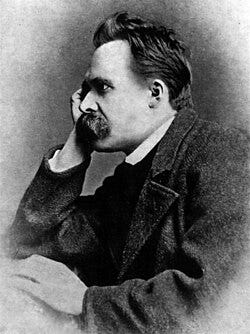
This is where Friedrich Nietzsche cuts through the illusion with unsettling clarity. He describes a kind of man who chooses comfort over calling, ease over becoming:
This is a deeper cultural pathology at work here, and Nietzsche saw it long before us. In Thus Spoke Zarathustra, he describes what he calls the “last man.” A man who abandons striving in favor of comfort, who replaces purpose with ease and calls it happiness: “We have invented happiness,” say the last men, and they blink. This is not strength; it is sedation. It is the quiet life of a man who avoids tension, avoids responsibility, and avoids becoming anything greater than he already is. And that is precisely what “happy wife, happy life” produces a man who no longer leads, no longer stands, no longer orders his life around a higher aim, but instead manages peace at the cost of his identity. He may appear stable, but internally he has already begun to shrink.
Nietzsche presses even further in Beyond Good and Evil, where he makes a claim that cuts directly against modern relational thinking: “One must learn to command oneself before one can command others.” The issue is not control over a woman—it is mastery of the self. A man who abandons his purpose in order to appease cannot command himself, and therefore cannot lead anything, not his life, not his relationship, not his future. What he calls “peace” is actually the collapse of internal hierarchy, the flattening of his values, the erosion of his center. And once that center is gone, the chain reaction begins: no purpose, no leadership; no leadership, no respect; no respect, no relationship. This is why the slogan sounds loving but functions destructively, it trains a man not to become stronger, but to become smaller.
And Nietzsche presses even deeper:
“He who has a why to live can bear almost any how.”
When a man loses his why—his purpose—he becomes reactive. He bends. He negotiates himself away. And in doing so, he loses the very thing that makes him stable: his center.
And without a center, there is no leadership.
Without leadership, there is no respect.
And without respect, love cannot survive.
⸻
The Silence of Adam: The Most Seductive Failure
Psychologist Larry Crabb names it well in his book, The Silence of Adam.

In Genesis, the first man and woman are placed in a garden with a clear calling and a clear boundary. Then the serpent enters and begins to distort what God has said—subtly, intelligently, persuasively. The woman is drawn into the conversation. She listens, considers, and moves toward what is forbidden.
And Adam is there.
Not absent. Not unaware.
There.
He does not step in.
He does not correct the distortion.
He does not protect the boundary.
He is silent.
Genesis tells us plainly that he was “with her,” and yet he said nothing. The serpent deceives the woman, but Adam abdicates responsibility. And the New Testament sharpens this distinction—“Adam was not deceived, but the woman was deceived” (1 Timothy 2:14). In other words, this was not merely a failure of knowledge—it was a failure of leadership.
And once that happens, everything changes.
Because if a man does not guard truth,
if he does not take responsibility for direction,
if he allows confusion to enter unchecked—
how can she possibly learn to respect him?
Respect does not grow in an environment where a man:
avoids responsibility
defers when clarity is needed
appeases rather than leads
From the earliest reflections of the Christian tradition, this moment has been understood as foundational. The early Church Fathers saw in Adam not simply the first sinner, but the first man who failed to stand in his role—who traded presence for passivity, and in doing so allowed disorder to take root.
And that pattern has never left us.
A man may think he is being loving by stepping back, by softening, by avoiding tension. But when he abandons responsibility, he removes the very structure that makes respect—and therefore love—possible.
At that point, the relationship is no longer alive in any meaningful sense.
It may continue outwardly—but internally, it has already died.
Looking back, I see this clearly now:
I did not love well because I did not lead well.
And I did not lead well because I had lost my purpose.
⸻
What I See Now
Now I see the difference.
Love does not require me to abandon my purpose—it requires me to anchor it more deeply.
I do not ignore her feelings. I listen to her, I take her seriously, I carry her stress with stability. But I no longer let them determine our direction when they are driven by fear, instability, or momentary despair. I do not shrink my vision to match anxiety. I do not reduce risk to preserve comfort. I do not negotiate away what I know is right.
Because she does not need a man who mirrors her instability—she needs a man who remains steady within it.
Men—hear me! A woman cannot respect you if you cannot handle your stress or and especially hers. And that man must not lose his purpose or convictions in the process.
So now I stand.
Not cold. Not dismissive. Not indifferent.
But grounded.
I lead with clarity even when she feels uncertain.
I move forward even when she feels afraid and that gives her a reason to trust me.
I hold direction even when emotions fluctuate.
And paradoxically, this is what restores peace, not the fragile peace of avoidance, but the durable peace of structure.
Because when a man refuses to abandon his purpose, he becomes someone she can trust again.
Not because he pleases her….
but because he is no longer lost.