

A Clue? It’s Already in Your Pocket
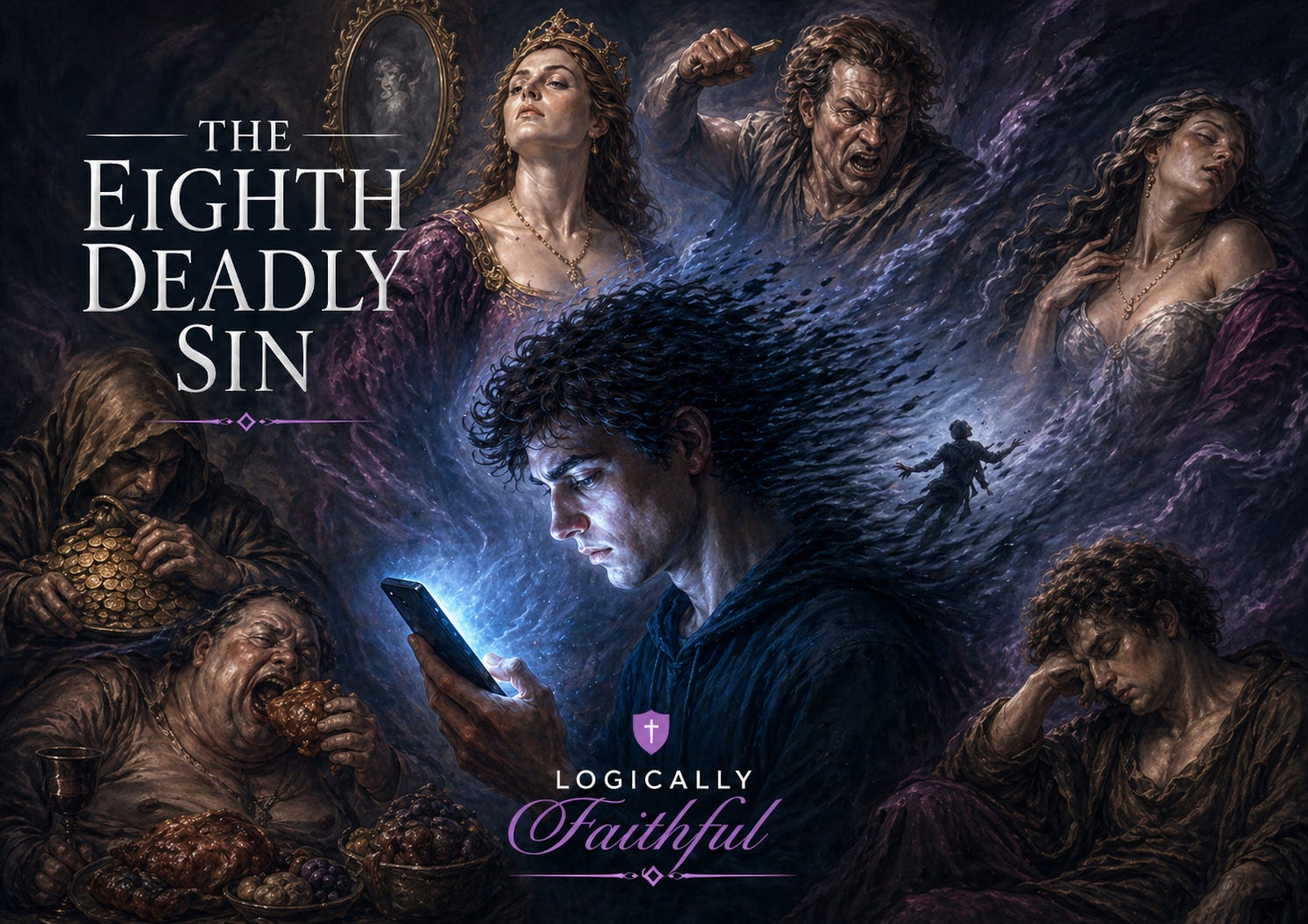
The internet rots the soul so quietly that we mistake decay for entertainment.
James Parker has written a short, sharp, unsettling piece in The Atlantic titled “The Eighth Deadly Sin.” The title alone feels like a dare. The old list seems complete enough: pride, envy, wrath, sloth, greed, gluttony, and lust. Seven is already a heavy diagnosis of the human condition.
Do we really need another?
Parker suggests that perhaps we do.
His essay begins with a scene that feels painfully familiar. A man sits before his laptop, staring almost brainlessly into the digital fog. He is not robbing a bank. He is not seducing his neighbor’s wife. He is not plotting murder. He is simply online.
Scrolling. Absorbing. Dissolving.
Becoming thinner as a human being by the minute.
Then the question rises: Is this a sin?
Not merely a bad habit. Not merely wasted time. Not merely a failure of productivity. A sin.
That is what makes Parker’s piece worth taking seriously. He is not merely asking whether the internet distracts us. Everyone knows that. He is asking whether the digital condition reveals a deeper moral and spiritual disorder. What if endless online life does not simply waste our attention, but deforms our soul?
Parker reaches back to the old Christian category of acedia. Acedia is often translated as sloth, but that word is too weak. Sloth sounds like laziness, as if the main problem is not getting off the couch. Acedia is darker. It is spiritual torpor. A heaviness of the soul. A disgust with the good. A restless boredom with reality itself.
The monk in his cell feels trapped by silence, prayer, obedience, and the slow labor of holiness. He does not necessarily become an atheist. He simply finds God boring. His body is present, but his soul has fled.
Now replace the monk’s window with an iPhone.
That is Parker’s genius. The eighth deadly sin is not simply “being online.” It is the peculiar spiritual condition produced by online existence: restless, distracted, irritated, overstimulated, undernourished, morally reactive, and strangely passive. We are not asleep, exactly. We are not awake either.
The digital sin does not burn.
It flickers.
It is the blue light of the soul.
But I think this eighth deadly sin needs a name. One word. Something as simple and severe as lust, greed, wrath, or pride.
Call it Drift.
Drift is the sin of unmanaged attention. It is the slow movement of the soul away from God, truth, duty, prayer, presence, and embodied love. It is not dramatic rebellion. It is spiritual evaporation.
Hebrews 2:1 gives us the perfect warning:
“Therefore we must pay much closer attention to what we have heard, lest we drift away.”
Notice the danger. The author of Hebrews does not say, “Pay attention lest you declare war on God.” He says, in effect, “Pay attention lest you float away.”
That is the modern soul online.
A person does not usually abandon God in one grand Nietzschean announcement. He drifts. One notification at a time. One late-night scroll at a time. One comparison, one outrage, one dopamine hit, one private indulgence, one hour of numbness after another.
The phone does not have to make you hate God.
It only has to make God feel less real than the feed.
That is why Drift may be the eighth deadly sin of the internet age. It is not merely one sin beside the other seven. It is the atmosphere in which the other seven become easier to breathe.
The internet does not create the seven deadly sins.
It gives them Wi-Fi.
It gives lust infinite novelty.
It gives envy a daily showroom.
It gives wrath a comment box.
It gives pride a platform.
It gives greed an endless marketplace.
It gives gluttony infinite content.
It gives sloth the illusion of productivity.
The old sins needed opportunity.
The internet gives them infrastructure.
This is why Drift is so dangerous. It does not feel evil. It feels normal. It feels like checking one more thing. It feels like a harmless break. It feels like Tuesday night.
A man can spend three hours online and emerge not rested, not wiser, not holier, not more courageous, not more loving, but merely agitated. He has seen ten scandals, three arguments, five attractive strangers, two political outrages, one influencer’s vacation, and a dozen half-read headlines. He knows more, perhaps, but understands less.
He has consumed information without receiving wisdom.
Christianity has always understood that sin is not only the breaking of rules. Sin is disordered love. It is loving lesser things more than greater things. It is allowing the soul to bend away from God and toward idols. Parker’s theological instinct is right here: the internet becomes spiritually dangerous when it trains us to love stimulation more than reality.
Of course, the internet itself is not evil. It can deliver sermons, Scripture, books, lectures, friendships, prayers, and encouragement. It can educate the ignorant, connect the lonely, expose injustice, and spread the Gospel.
The problem is not only what we do with the tool.
The problem is what the tool does with us.
We like to think we use technology. Often, technology uses us. It schedules our attention. It rewards our vanity. It monetizes our anger. It studies our weakness. It knows when we are lonely, bored, insecure, jealous, aroused, restless, or afraid. Then it offers us exactly what will keep us there.
This is not neutral.
A casino is not neutral simply because no one forces you to pull the lever. A slot machine with a Bible verse taped to it is still a slot machine. Much of our digital world is engineered not to serve the soul, but to capture it.
That is why the answer cannot be merely technical.
We do not only need screen-time limits. We need repentance.
We do not only need digital detoxes. We need reordered loves.
We do not only need better habits. We need a better vision of the human person.
The Christian answer to Drift is not simply, “Put down your phone.” That may be necessary, but it is not sufficient. The deeper answer is: recover the weight of glory. Recover the dignity of being made in the image of God. Recover silence. Recover prayer. Recover embodied friendship. Recover worship. Recover boredom, even, because boredom may be the doorway through which the soul remembers that it is hungry.
We are afraid of silence because silence tells the truth.
In silence, we discover that much of what we call “connection” is avoidance. Our outrage often masks impotence. Our entertainment often hides sadness. Our busyness often conceals fear. Our scrolling is not harmless. It is a liturgy. It trains us. It catechizes us. It teaches us what to love, what to hate, what to desire, what to mock, and what to ignore.
Every feed forms a soul.
That is why Christians should be more serious about this than almost anyone. We believe the soul is not a metaphor. We believe attention is moral. We believe habits shape character. We believe worship is formative. We believe demons do not always need possession when distraction will do.
The devil does not have to make you hate God if he can make you too distracted to notice Him.
So perhaps we need a new examination of conscience for the digital age:
Did I use the internet today, or did it use me?
Did my time online make me more loving, truthful, courageous, and present?
Did I become more grateful or more envious?
More patient or more irritable?
More prayerful or more numb?
More human or less?
James Parker’s article is valuable because it names what many of us feel but rarely confess. We know something is wrong. We know the screen is not merely a screen. We know our souls feel thinner. We know our attention has been colonized. We know we are increasingly informed and increasingly unwise.
The eighth deadly sin is Drift.
Not atheism. Not lust. Not greed. Not even pride. Something quieter. The slow loss of attention to God while the thumb keeps moving across glass.
Sin rarely announces itself honestly. It does not say, “I am here to deform your soul.” It says, “You deserve a little escape.”
And maybe you do need rest.
But rest restores you.
Drift drains you while pretending to comfort you.
The cure is older than our machines.
Get offline.
Get honest.
Get quiet.
Get on your knees.
Because the soul will not be saved by better scrolling. It must be rescued by grace, disciplined by truth, and awakened again to the living —yes living God.
What a great article. Excellent, Logically!