


“If the soul loves anything more than the truth, it becomes captive to that thing.”
— Augustine
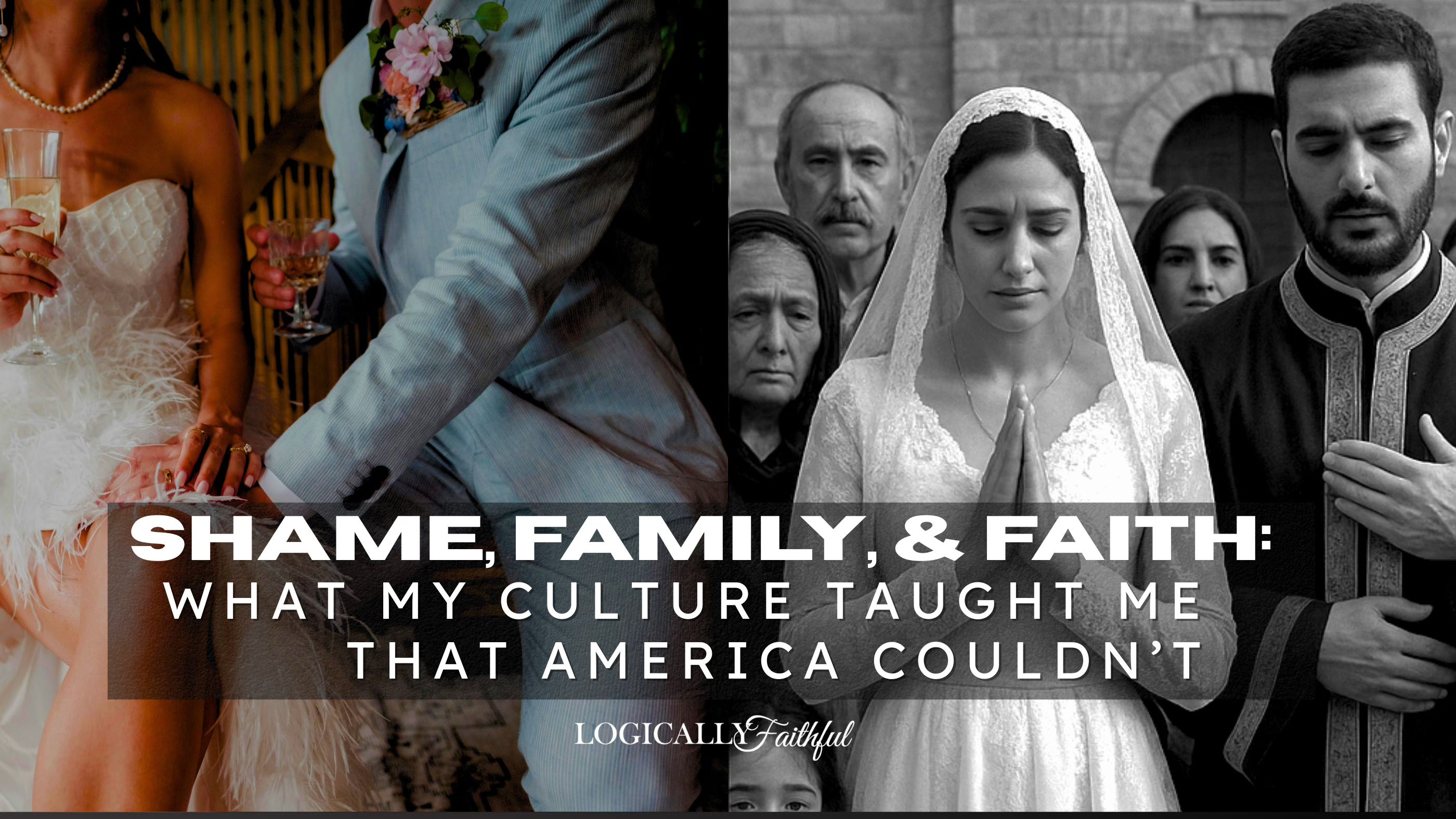
I have lived most of my life between two moral universes.
One taught me that truth whispers inside the conscience. The other taught me that my name was a vessel carrying the honor of my ancestors. One told me to follow my truth. The other asked me daily, “Shu rah y’gool al-nas?” (شو راح يقول الناس؟) — “What will people say?”
To be raised Arab and Christian in the West is to grow up bilingual not only in language, but in morality.
I. Two Moral Worlds, One Soul
In my American classrooms, moral knowledge was internal:
“Do what feels right to you.”
But inside my home, the moral question was external:
“Shu rah y’gool al-nas?”
What will the people think?
That short Arabic phrase carried the weight of centuries. It contained fear, wisdom, caution, pride, and sometimes unspoken pain. It was less a question and more a cultural instinct, a reflex passed down through generations that had survived invasions, migrations, arranged marriages, church persecutions, and the fragile politics of small villages.
Anthropologists and psychologists have been mapping these differences for decades. Ruth Benedict’s foundational work describing shame cultures and guilt cultures identified the core split: in guilt cultures, morality comes from violating one’s internal conscience; in shame cultures, morality arises from violating communal expectations and losing face in the eyes of others.
I didn’t know this academically as a child — I only knew that the rules changed depending on which world I stepped into.
II. The Family as a Moral Ecosystem
Confucius would have understood my family better than many Western philosophers. He taught that morality begins with honoring your parents and radiates outward like ripples in water.
In my grandparents’ Jordanian village, this was not philosophy.
It was life.
Your reputation was your currency. Your daughter’s behavior could affect the marriage prospects of her cousins. Your son’s public failure could become a family tragedy. Good conduct was not merely personal — it was ancestral.
There was an Arabic phrase my grandmother used more than once when she feared scandal:
“Laish tfadḍaḥna?” (ليش تفضحنا؟)
“Why would you expose us? Why shame us?”
Not “Why did you do wrong?”
but “Why did you make us look wrong?”
It was a different moral grammar.
Modern cultural psychologists Joseph Vandello and Dov Cohen call this an honor culture, a social system where maintaining reputation often outweighs personal preference and even personal safety. In such cultures, threats to honor can trigger strong emotional, social, and sometimes violent responses, particularly when reputation is tied to masculinity, purity, or family dignity.
III. Childhood Lessons in Appearance and Reality
When I was eleven, I stood outside a Chicago corner store waiting for a friend. A neighbor later told my father he’d seen me “with bad boys” and implied something suspicious. Nothing actually happened. There was no wrongdoing. Only the appearance of it.
My father sat me down that evening and said softly:
“Ismna mish ilak bas.” (اسمنا مش إلك بس)
“Our name is not yours alone.”
He wasn’t disciplining me.
He was warning me.
In honor-shame cultures, morality is not solely about actions.
It is also about perception, reputation, whispers, and narrative.
An American might say, “Who cares what people think?”
An Arab mother will answer, “Everyone.”
IV. The Generational Chain: Roots, Tension, and Transformation
Three generations formed the moral ecosystem of my identity.
Grandparents
Honor was their oxygen. Reputation determined destiny. Shame could destroy families. Their ethics were communal and survival-based.
Parents
Caught between two worlds, they feared assimilation as much as sin. They carried old-world caution into an American ecosystem that neither understood nor reinforced it.
My Generation
We grew up with report cards and church icons, American freedom and Arab restraint. We were asked to become arrows flying into the future while still honoring the bows that launched us.
Kahlil Gibran understood this tension intimately.
He wrote,
“Your children are not your children…”
but he also wrote of Lebanon as a mother whose love is both fierce and demanding.
We lived in that tension.
V. Shame’s Shadow: Why Women Carry More of the Burden—and Why Honor Killings Are Rare in the U.S.
In most honor–shame cultures, there is a painful double standard: a woman’s virtue is treated as more important than a man’s. Everyone knows it. Few say it out loud.
On the surface, people might explain it with phrases like:
“Al-mar’a ‘ird al-‘a’ila.” (المرأة عرض العائلة)
“The woman is the family’s honor.”
Men may be expected to be strong, providers, even hot-tempered. But women are expected to be pure. Her reputation, her sexuality, her choices in love and marriage—all of these become symbolic of the family’s moral worth. As one study of young women from honor cultures in Sweden puts it, “A woman’s honor tumbles down on all of us in the family, but a man’s honor is only his.” DIVA Portal
Why this asymmetry? Part of it is brutally practical: in many traditional societies, descent, inheritance, and belonging are traced through the father, but the mother’s body is the one that actually carries and births the child. That creates an obsession with paternity certainty—the need to be sure whose child it is. Anthropologists and social psychologists have shown that in cultures of honor, female sexual chastity becomes a primary marker of both male and family honor, because it supposedly guarantees clear bloodlines and social stability. Compass+1
In other words:
A man’s sexuality is seen as his character flaw or strength.
A woman’s sexuality is seen as everyone’s moral status.
So the woman’s body is treated as both sacred and dangerous. Sacred, because she literally houses life. Dangerous, because any “misuse” (real or imagined) threatens the symbolic order.
Recent research on honor-based violence describes the female body as the “symbolic site where notions of purity, family reputation, and social order are negotiated and enforced.” Crime Justice Journal+1 So when you say, “her body is more sacred because she can house life itself,” you are describing an intuition that many cultures have weaponized: the life-bearing power of women becomes the excuse for controlling them.
On the ground, this looks like a thousand small and large controls:
A brother insisting on reading his sister’s messages “for her own protection.”
A father forbidding his daughter from going out with friends in mixed company, even when sons roam freely.
A cousin whose entire “value” as a marriage partner is reduced to whether she is perceived as a virgin—while her future husband’s sexual past is an open secret and largely ignored.
Social psychologists call this gender-specific honor codes: women are tied more tightly to norms of chastity and modesty, while men are tied to norms of toughness, status, and the ability to defend the family’s reputation. SAGE Journals+1 Studies have shown that when these honor codes are threatened—especially by rumors or signs of female sexual autonomy—families experience deep shame, which can erupt into coercion, confinement, and in extreme cases, violence. ScienceDirect+1
This is the context in which honor killings arise.
Sociologically, honor killings occur most often where the entire social environment participates in this logic: neighbors, extended family, sometimes even local officials. In these contexts, a woman’s perceived sexual transgression—dating the “wrong” man, refusing a forced marriage, being seen alone with someone, or even being a victim of rape—is interpreted as a stain on the family’s honor that “tumbles down on all of us.” SIT Digital Collections+2PubMed+2
In that twisted moral world:
A man can recover his honor by controlling or punishing a woman.
A woman can “restore” her family’s honor only by erasing herself—through seclusion, exile, or in the worst cases, death.
Sociological and criminological studies have found that such codes operate as informal systems of social control, restricting women’s autonomy and making female sexuality a matter of collective, not individual, concern. Crime Justice Journal+2DIVA Portal+2 When everyone believes that “if she falls, we all fall”, extreme measures, including honor killing, become thinkable—even “necessary”—for those fully captive to this worldview. It is not that they hate the victim as a person; it is that they have learned to fear shame more than death.
By contrast, the moral soil in the United States is different. The wider culture is primarily guilt-based and individualistic. Legally and publicly, the question is, “What did this person do?” not “What did she do to us?” The state, at least on paper, does not recognize “honor” as a mitigating factor when someone kills.
There are cases of honor-based violence in the U.S.—immigrant families bringing old codes into new soil. A Justice Department–sponsored exploratory study estimated roughly 23–27 honor killings per year in the United States, a tiny fraction of total homicides, and noted that identifying such cases is difficult because they are often processed simply as domestic violence or homicide without an “honor” label. Office of Justice Programs+1 A later NIJ policy overview and advocacy reports from groups like the Tahirih Justice Center echo this: honor-based abuse exists, but it is not a systemic, socially endorsed pattern in the wider culture. Office of Justice Programs+2Tahirih Justice Center+2
That matters. It means:
The “village” is largely absent.
The extended social enforcement network is fractured.
Religious or cultural justifications do not confer legal legitimacy.
Even those who hold honor-shame values must navigate a system that, at least formally, cares more about individual rights than collective face.
This doesn’t mean American culture has solved violence against women—far from it. It simply means the logic behind most gender-based violence is different. It’s often driven by control, jealousy, misogyny, or mental illness—but not by a shared cultural consensus that a woman’s sexuality carries the fate of the entire extended family.
So we end up with a tragic irony:
In some honor cultures, women are seen as more virtuous, more sacred, more symbolically central—and therefore bear a crushing, unequal burden. Their bodies are treated as holy ground, but patrolled like occupied territory.
In guilt-based cultures like the U.S., women may be formally equal in law, yet often find their bodies commodified, hypersexualized, or trivialized—without the language of “sacredness,” but also without the village-level obsession with “sharaf” (honor) that makes honor killings broadly thinkable.
As someone who loves his Arab Christian heritage, I can acknowledge the beauty in seeing a woman’s capacity to bear life as profound and holy. But as a philosopher and a follower of Christ, I have to say: whenever “holiness” becomes a pretext for control, fear, or violence, it has ceased to be holy. It has become an idol.
The task, then, is not to deny the sacredness of the woman’s body, but to honor it rightly—as belonging first to God and to herself, not to the fragile egos of men or the anxieties of a village.
VI. Conclusion: We Are the World In Between
If you grew up Arab and Christian in America, this is your story too. You learned to navigate two worlds, two moral grammars, two emotional ecosystems.
You learned to hold your family’s name in one hand
and your personal calling in the other.
You learned when to listen to the village
and when to listen to God.
You learned to translate cultures for parents, siblings, professors, pastors, and sometimes for yourself.
And though the worlds often contradict each other, you are not split — you are woven.
You are the living conversation between past and future.
Between guilt and honor.
Between conscience and community.
Between Augustine’s inner voice and your grandmother’s whispered warning:
“Shu rah y’gool al-nas?”
What will the people think?
Perhaps, finally, the answer is:
They will think we have learned to carry both worlds with grace.
This is AMAZINGLY well said. I can relate to so much of what you said, first from having grown up Amish in the midst of American culture where 'vas tsella liet danga?', that is, 'What will people think?' was the constant mantra and motivation. Later living life alongside Arab women in the ME for 25 years I saw and experienced everything you mentioned vicariously through my dear friends. Thank you for dissecting these issues with compassion and clarity.