


On March 8, 2014, Malaysia Airlines Flight 370 vanished. It carried 239 souls—12 crew members and 227 passengers from 14 nations. They disappeared into silence over the Indian Ocean, leaving behind a wake of grief that circled the globe.
For months, nations pooled their resources. Satellites swept vast oceans. Submarines combed the deep. Millions of dollars were spent searching for lives that had vanished into the dark. Why? Because even though we did not know their names, we knew they were more than statistics. The world mourned, because we instinctively know that people are not things. That flight is still missing and those souls too, as if this writing.
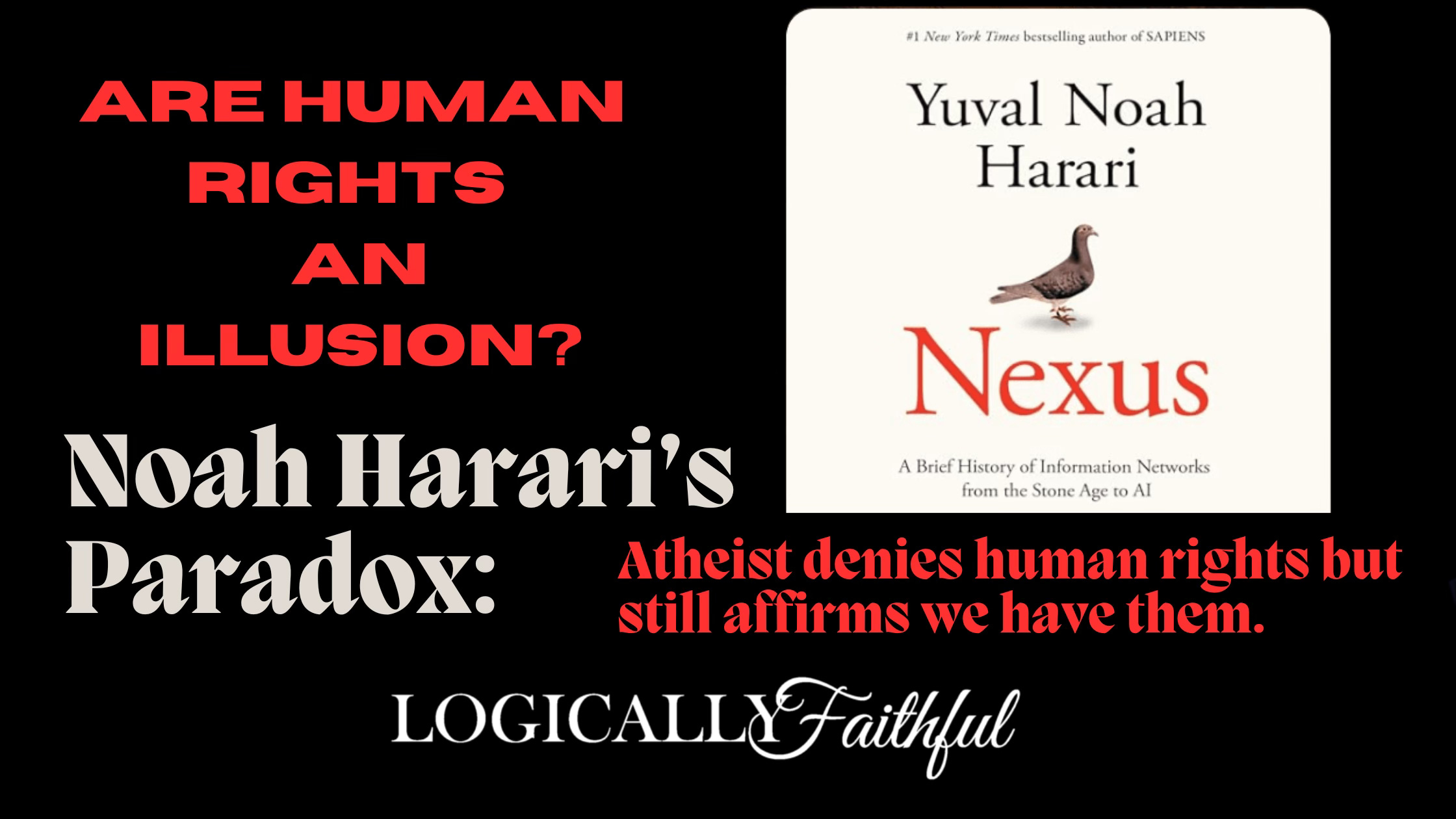
Now enter Yuval Noah Harari. He is an Israeli historian and bestselling author whose works — Sapiens: A Brief History of Humankind, Homo Deus: A Brief History of Tomorrow, and 21 Lessons for the 21st Century — have made him one of the most influential secular voices of our time. Educated at the Hebrew University of Jerusalem and Oxford, Harari examines humanity’s past, present, and possible post-human future through the lenses of evolution, data science, and technology. A self-described atheist and materialist, he argues that ideas such as God, the soul, nations, and even human rights are useful fictions — stories humans invent to create social cooperation. His vision, at once brilliant and chilling, suggests that artificial intelligence and bioengineering may soon redefine what it means to be human.
Yet behind his sweeping analyses lies a striking contradiction: while dismissing the divine foundations of morality, Harari continues to employ the very ethical categories — justice, equality, and dignity — that only make sense if humans are more than biological accidents.
If Yuval Noah Harari is right, that instinct is a mirage. He writes:
“Human rights, just like God and heaven, are just stories that we’ve invented… The only place you find rights is in the stories we have invented and spread around.”
(Homo Deus: A Brief History of Tomorrow)
And elsewhere:
“According to the science of biology, people were not ‘created.’ They have evolved. And they certainly did not evolve to be equal. The idea of equality is inextricably intertwined with the idea of creation… If we do not believe in the Christian myths about God, creation, and souls, what does it mean that all people are created ‘equal’?”
(Sapiens: A Brief History of Humankind)
If Harari is correct, then the millions spent searching for Flight 370 were wasted on sentimental fiction. The passengers were not sacred lives, merely “evolved animals” whose rights exist only in the imagination of their species. But our hearts—and even Harari’s own moral vocabulary—betray this nihilistic logic. He still speaks of “injustice,” “dignity,” and “dangerous power,” words that only make sense if morality is more than human preference.
Why Morality Must Be Objective
If morality is subjective, then morality is meaningless. A “man-made” moral system has no more authority than a traffic signal drawn in chalk. If human rights are inventions, then they can be uninvented. Hitler was simply “editing the narrative.” Stalin was just “testing a hypothesis.”
Imagine this: a teacher walks into a classroom and says, “There are no right or wrong answers.” Then she marks the students’ exams and fails half of them. The students protest—and rightly so. You can’t grade by a standard that doesn’t exist. Likewise, Harari’s worldview declares that morality is fiction—then grades civilization as if moral standards were real.
Or picture a society that claims justice is a social construct. You are accused of a crime you didn’t commit, dragged before a judge, and sentenced to death. You protest: “But this is wrong!” The judge replies, “Right and wrong are just cultural myths.” In that moment, you realize that relativism cannot sustain justice—it only sustains power.
If morality is subjective, then morality is meaningless. A “man-made” moral system has no more authority than a traffic signal drawn in chalk. If human rights are inventions, they can be erased as easily as they were imagined. Hitler becomes merely an editor of the narrative; Stalin, a grim experimenter. Aristotle would have seen at once that this view tears reason from its roots. In Nicomachean Ethics, he argues that every being has a function—its ergon—and that goodness is the fulfillment of that function. A knife’s goodness lies in cutting well; a human’s in reasoning well about how to live. If there is no objective good, practical reason has no target. To deny a real telos for human life is to make reason itself purposeless, like an eye that cannot see or a flute without music.
Aristotle’s world is teleological: ends and purposes give shape to action. Harari’s world is purposeless, a sequence of biochemical algorithms whose only law is efficiency. But laws of efficiency cannot tell us why cruelty is wrong or compassion admirable. Without an objective telos, moral “oughts” collapse into personal preferences. The relativist insists that justice is a social construct—until he himself is wronged. Then he appeals, instinctively, to a standard higher than custom. This is why Aristotle distinguished between natural justice—what is right “everywhere alike”—and mere legal justice, the conventions of a city. We know wicked laws exist, and we condemn them because we measure them against a natural moral order that transcends decree. If all justice were conventional, no law could ever be unjust—only unpopular.
Virtue is a mean between excess and deficiency, but the mean makes sense only if there is a real good to aim at. Courage lies between rashness and cowardice because it serves the objective good of preserving life under rational fear, not because society prefers moderation. Likewise, his concept of phronēsis, practical wisdom, is not cleverness but the truthful discernment of the good in particular circumstances. Strip truth from the good, and phronēsis degenerates into manipulation—a vice, not a virtue. In that sense, a purely man-made morality is self-defeating: it asks us to reason well about something it says does not exist.
Even common life testifies against moral relativism that is assumed by Harari. The thief who hides his act confesses by concealment that it is wrong; he does not defend stealing as good, only as necessary. The murderer who pleads justification, not pride, betrays a conscience he cannot silence. Cultures differ in custom, but not in the awareness of right and wrong. This universal moral sense is what C. S. Lewis later called the Tao—a law written into the structure of reality and echoed in every heart. Harari must borrow from that moral capital even to critique religion, power, or technology. He borrows the wood of Christian and classical virtue to burn down the house that shelters him.
To deny objective morality is to blind the very eye that sees truth. You cannot grade students without a standard, nor govern a people without justice, nor reason about ethics while denying that good and evil are real. Aristotle’s simple insight remains the deathblow to relativism: if we are beings with a function ordered toward flourishing, then the good is not a fiction—it is the most real thing about us.The moral law is not a cultural invention; it’s a compass embedded in every conscience. Cultures disagree about how it’s applied, but not that it exists. Even when a thief steals, he hides his act because he knows it’s wrong. He doesn’t argue that stealing is good—he only argues that this time, it was “necessary.”
C.S. Lewis called this the Tao—the universal moral law that transcends tribe and time. It’s what makes Harari’s moral outrage possible. He must borrow the wood of Christian morality to burn down the house of Christianity.
The Logical End of Moral Subjectivism
Without objective morality, cruelty and kindness are morally indistinguishable. Compassion becomes a chemical reaction; love a survival mechanism. Yet even the most hardened materialist cannot live consistently that way. He may say that morality is fiction, but when someone lies about him, steals from him, or harms his child, he suddenly speaks as though morality were real—and binding.
This reveals what philosophers call the performative contradiction: denying morality while depending on it. Harari condemns humanity’s “delusions,” but moral condemnation presupposes a real standard of right and wrong. If morality is invented, there is no moral authority to condemn anything—not genocide, not tyranny, not deception.
And that is precisely why atheism, if followed to its logical conclusion, becomes unlivable. It amputates the very foundation upon which it stands. The atheist must borrow moral meaning from the theistic worldview while denying the reality of the God who grounds it. This is Harari’s paradox: he borrows morality while denying its Maker.
The God Behind Human Dignity
The idea that every human being has equal worth did not emerge from biology or reason—it emerged from theology. From the declaration that all humans are made imago Dei, in the image of God (Genesis 1:27). Our worth is not earned through intelligence, usefulness, or data; it is bestowed by our Creator.
When that foundation is removed, dignity becomes negotiable. History’s worst tyrannies began not with hatred, but with redefinition—when some lives were deemed less valuable than others. Harari’s “useless class” is not far from the language that justified slavery, eugenics, and extermination.
Objective morality is not a chain to enslave us—it is the ground beneath our freedom. It’s what allows us to say, without hesitation, that every person matters, that cruelty is wrong, that truth is sacred. To deny this is not to become enlightened, but to drift into darkness disguised as reason.
The world searched for Flight 370 not because of utility, but because every life is sacred. And that sacredness points beyond evolution, beyond economics, beyond fiction—to the Author of truth, the Lawgiver of justice, and the Giver of worth.
Final Thought
If morality is a story, it is one that refuses to die—because it was never invented. It was revealed. The cry for justice, the ache for meaning, the grief over the lost, and the love we cannot explain—all of it bears witness to something eternal.