

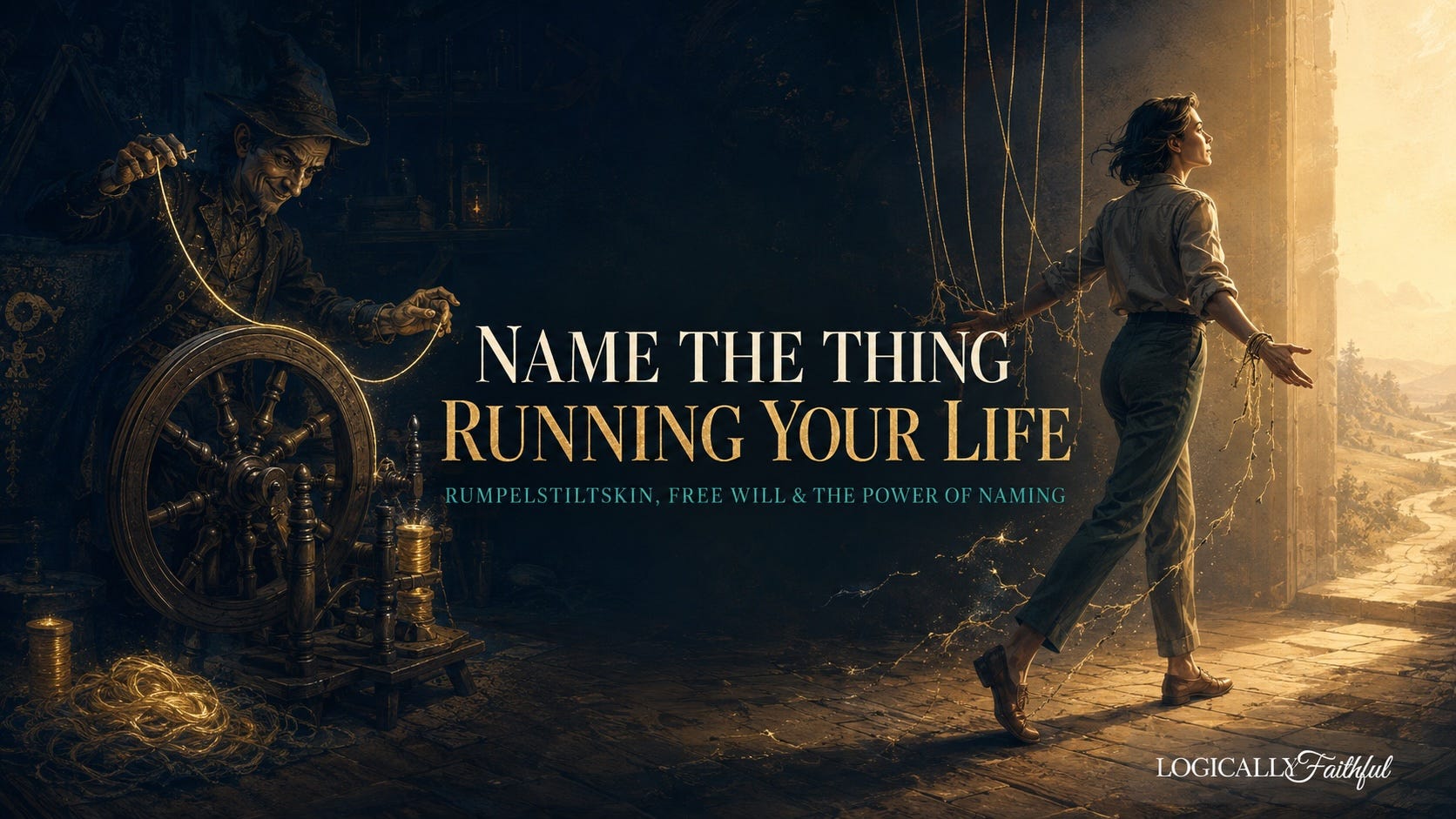
There is an old children’s story, first published by the Brothers Grimm in 1812, about a little man with a ridiculous name. You probably know the name: Rumpelstiltskin. But knowing the name is actually the whole point of the story.
The tale begins with a miller who makes the sort of boast that would today get someone fired, sued, or promoted into upper management. He tells the king that his daughter can spin straw into gold. She cannot. The king, apparently short on both skepticism and emotional intelligence, decides to test the claim. He locks the young woman in a room piled high with straw and orders her to turn it into gold by morning.
She sits there terrified, surrounded by an impossible task she never asked for. Then a strange little man appears. He can do what she cannot, but he wants something in return. The first night, she gives him her necklace. The second, her ring. By the third night, she has nothing left, so the bargain becomes darker: if he saves her again, she must promise him her firstborn child when she becomes queen.
She agrees.
It is easy to condemn terrible bargains when you are not the person locked in the room.
Years pass. The woman becomes queen and eventually has a child. Then the little man returns to collect what he was promised. Horrified, she begs him not to take the baby. At last, he offers her one way out. If she can discover his name within three days, she can keep her child.
She guesses every name she can think of, but nothing works. Then a messenger traveling through the countryside happens upon the strange little man dancing around a fire in the woods. He is celebrating his victory and singing to himself that the queen will never guess his name.
Rumpelstiltskin.
The messenger returns. The queen confronts him. She speaks the name.
The Power of a Name
That is the turning point.
No sword is drawn. No army storms the castle. No productivity guru arrives with a seven-step morning routine involving cold plunges, gratitude journals, and getting up at 4:37 a.m. The queen simply knows what to call him. And the thing that seemed mysterious and all-powerful suddenly loses much of its power.
That old story has survived for a reason. Human beings have always sensed that unnamed things possess a peculiar authority over us. A fear we cannot name feels less like fear and more like reality. A shame we cannot name feels less like an emotion and more like identity. A pattern we cannot name feels less like a habit and more like fate.
This is one of the stranger truths of the inner life: sometimes the first step toward freedom is not defeating the monster. It is learning its name.
The Respectable Disguises of Fear
The problem is that most of our monsters are far better disguised than Rumpelstiltskin. They do not dance around campfires announcing themselves. They come to work with us. They answer email. They make sensible arguments. Fear says, “I’m just being realistic.” Perfectionism says, “I have high standards.” People-pleasing says, “I care about people.” Control says, “I’m being responsible.” Avoidance says, “I just need more time to think.”
And overthinking? Overthinking usually buys another notebook.
We are astonishingly good at giving respectable names to the things that imprison us. A man may spend five years talking about leaving a job he hates. He reads books, takes assessments, listens to podcasts, makes spreadsheets, updates the spreadsheets, and perhaps changes the font on the spreadsheets. At some point, information is no longer the problem. The problem may be one sentence he has not wanted to say: “I am afraid that if I try something new and fail, people will discover I am not who they think I am.”
That sentence hurts more than “I need more information.” It is also infinitely more useful.
You cannot negotiate with fog. You can confront a sentence.
When a Wound Becomes an Identity
This is where naming becomes powerful. Psychology gives us terms such as avoidance, projection, catastrophizing, perfectionism, resentment, shame, and fear of abandonment not because vocabulary is magical, but because language gives form to what had felt shapeless. “I feel terrible” can become “I am ashamed.” “I hate my job” can become “I am afraid I spent fifteen years becoming successful at something I never wanted.” “My spouse makes me furious” can become “I feel invisible, and anger is easier to admit than loneliness.”
Precision can be uncomfortable. It can also be liberating.
The mind plays another trick as well. Something happens to us, and then we quietly convert the event into an identity. “I failed” becomes “I am a failure.” “Someone rejected me” becomes “I am unlovable.” “I do not know what to do next” becomes “I am lost.”
A fact about one moment becomes a verdict on the whole person.
We do this constantly, and intelligence does not protect us from it. In some cases, intelligence makes the problem worse. A clever person can construct a very sophisticated prison and then give an impressive lecture about its architectural virtues.
The examined life begins when we become willing to question the stories we tell ourselves. Not because every story is false, but because some stories began as explanations and gradually became excuses. Some began as wounds and eventually became identities.
There is an enormous difference between saying, “I am afraid,” and saying, “I am a coward.” Between “I failed” and “I am a failure.” Between “I have spent years avoiding conflict” and “That is simply who I am.”
One describes something happening within you. The other hands it the deed to the house.
The Monster That Once Protected You
There is another complication. Not every destructive pattern began destructively. Some of our monsters started life as bodyguards. The child who learned to please everyone may have grown up in a home where keeping people happy kept the peace. The perfectionist may have learned early that achievement brought affection. The emotionally guarded person may have discovered that vulnerability was rewarded with ridicule. The controlling person may once have lived in a world where nobody else could be trusted.
These strategies may have made sense once.
Armor is useful in battle. It is less useful at dinner.
A survival strategy that protected you at fifteen can quietly imprison you at forty-five. That means the better question is not merely, “What is wrong with me?” A more useful question is, “What is this pattern trying to protect me from, and do I still need its protection?”
That is where compassion and responsibility meet. You do not have to despise the frightened version of yourself that developed the strategy. But neither do you have to let that frightened version continue running your life.
Success Can Hide a Lot
This becomes especially interesting when people become successful. Failure tends to expose our fears quickly. Success can hide them for decades. Achievement is an excellent anesthetic. You can outrun a surprising amount of inner confusion with promotions, degrees, titles, money, deadlines, applause, and a very full calendar.
Until one day you cannot.
A man reaches fifty and realizes he has become extraordinarily good at something he is no longer sure he wants to do. Another discovers that his family knows his schedule better than they know him. Another cannot rest without feeling guilty. Another has spent thirty years becoming important and now quietly wonders why being important does not feel more important.
Then comes the frightening question: If I am not what I accomplish, who am I?
That is not really a career question. It is a human question.
And it cannot be solved by optimizing the calendar.
The Sentence You Don’t Want to Say
Sometimes what we need is not another productivity system but the courage to say a sentence we have been avoiding.
Try this one: “The thing I have not wanted to admit is…”
Then stop.
Do not give the respectable answer. Do not give the answer suitable for LinkedIn. Do not give the version that makes you look wise, wounded, and photogenic. Give the answer that stings a little.
Maybe it is, “I am terrified of disappointing people.” Or, “I need people to think I am successful.” Or, “I keep blaming my circumstances because admitting I have a choice would require me to make one.” Or, “I am angry because anger feels stronger than admitting I am lonely.” Or perhaps, “If I stopped achieving, I am not sure I would know why I matter.”
There it is.
Now psychologists sometimes call this affect labeling: putting a precise word to what you are feeling. Research by Matthew Lieberman and colleagues found that naming negative emotions was associated with reduced activity in the amygdala and greater engagement of prefrontal regions involved in regulation, while related work on emotion differentiation suggests that people who can distinguish between emotions such as shame, anger, grief, envy, and fear often regulate them more effectively than people who experience only a vague sense of “feeling bad.” [Lieberman, Matthew D., et al. “Putting Feelings Into Words: Affect Labeling Disrupts Amygdala Activity in Response to Affective Stimuli.” Psychological Science, vol. 18, no. 5, 2007, pp. 421–428. https://doi.org/10.1111/j.1467-9280.2007.01916.x]
Naming does not magically solve the problem, but it can create psychological distance: “I am afraid of failing” is different from “I cannot do this,” and “I feel ashamed” is different from “I am worthless.” A name turns an invisible atmosphere into something you can examine, question, and respond to. That is why Rumpelstiltskin is such a fitting metaphor: the name is not the whole solution, but without it, the real work can hardly begin.
Rumpelstiltskin.
Naming Is Only the Beginning
Of course, naming something does not solve everything. You can understand perfectly well why you behave badly and continue behaving badly with remarkable consistency. Self-awareness can become another form of procrastination. “I understand my attachment style” is useful. “Did you apologize?” is often more useful.
Insight without action can become sophisticated avoidance.
But naming still matters because it changes the relationship. Once you can say, “That is fear,” or “That is my need for approval,” or “That is the old belief that I must earn love,” you create some distance between yourself and the thing. You can examine it, question it, test it, and, when necessary, disobey it.
That is the beginning of freedom. Not the absence of fear, but the refusal to treat fear as your highest authority.
So What Is Your Monster’s Name?
Perhaps it is failure. Perhaps rejection. Perhaps control. Perhaps loneliness. Perhaps the need to be indispensable. Perhaps the belief that if people really knew you, they would be disappointed. Or perhaps your monster has been around so long that you have stopped recognizing it as something separate from yourself.
That is what makes the old fairy tale so enduring. Rumpelstiltskin’s power depended partly on remaining unknown. Once the queen could point to him and say, “I know who you are,” the relationship changed.
The same thing can happen inside us.
You do not need to hate your monster. You do not need to pretend it never helped you.
You simply need to stop confusing its voice with your own.
Read that again—yes. Read it again.
Name it. Understand it. Then decide whether it still deserves your obedience.
Because perhaps the thing you have been calling “just who I am” is not who you are at all.
Perhaps it is simply an old little man dancing around a fire, hoping you never learn his name.
If you have reached a place in your career, relationships, or life where the usual explanations are no longer working, this is exactly the kind of conversation I explore in coaching. We identify the pattern, understand where it came from, and decide what you want to do now that you can finally see it.
If you are ready, book a confidential 30-minute “Name Your Monster” conversation with me.
Sometimes changing your life begins with something surprisingly small.
You say the name.