


There are some questions a person studies in books, and there are other questions that come into the room, sit beside you, and never leave.
The problem of evil became that kind of question for me when my son Enoch died in my arms on September 20, 2006.
I remember holding him, loving him, praying for him, and knowing that I could not keep him here. I later buried him. Since then, whenever someone speaks about the death of a child as though it were merely an argument to be won, a puzzle to be solved, or evidence to be placed neatly on one side of a philosophical scale, something in me resists. The death of a child is not neat. It does not remain inside the boundaries of logic. It enters the bones. It changes the sound of silence. It divides life into what came before and what came after.
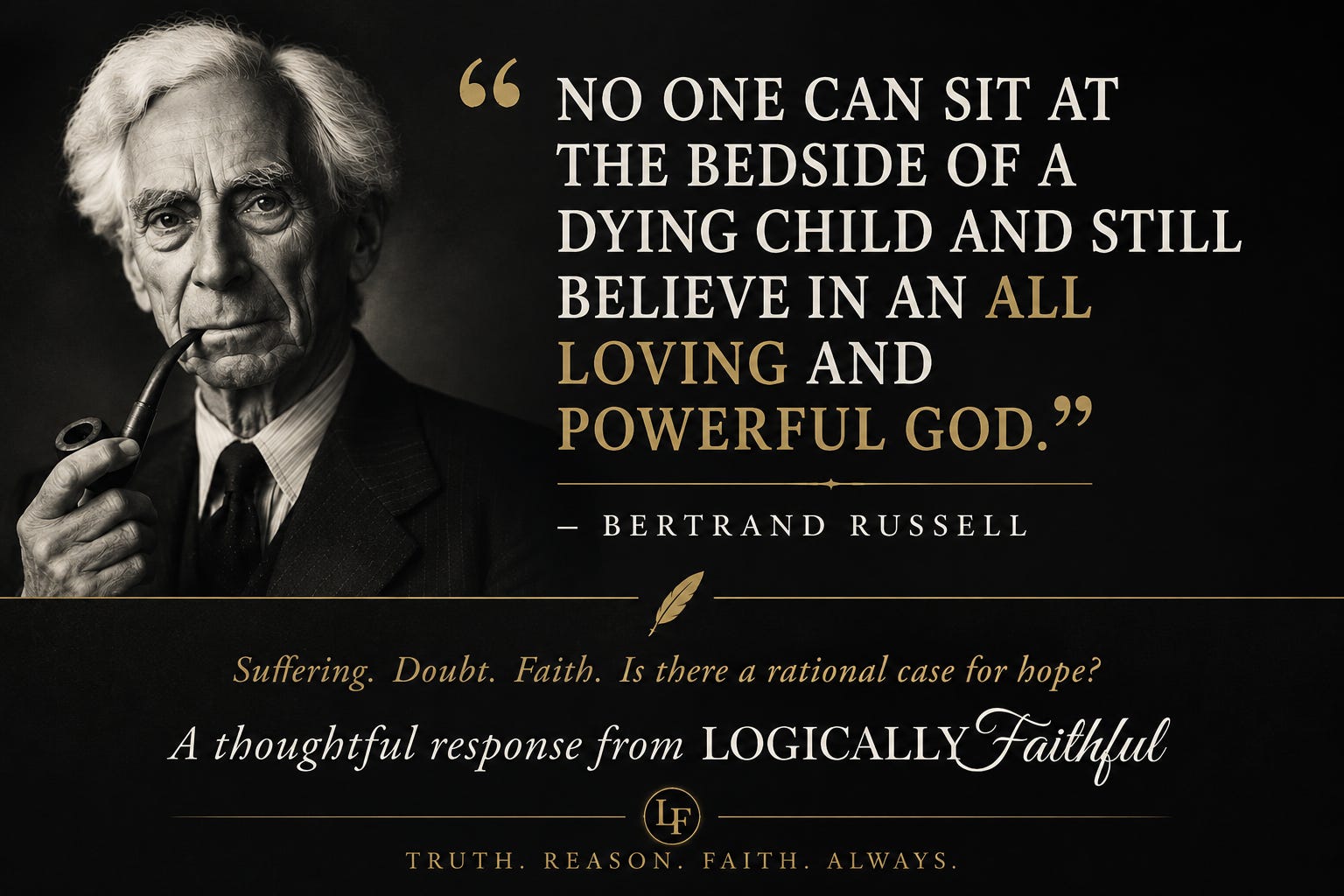
So when Bertrand Russell is credited with saying that “no one can sit at the bedside of a dying child and still believe in an all-loving and all-powerful God,” I do not dismiss the force of the statement.
I understand it more deeply than I wish I did.
But I also know that it is false.
I did not merely sit beside a dying child. I held my son as he died. I buried him. I still grieve him. And I still believe in God, and it is not blind faith.
That does not mean I possess an easy answer.
In fact, anyone who offers an easy answer to the death of a child has probably not understood either the child or the question. Russell’s statement has the power of a cry, but a cry is not yet an argument. It expresses one of the deepest forms of the evidential problem of evil: if God is omniscient, omnipotent, and perfectly good, why does He permit the suffering and death of innocent children? If God knows, He is not ignorant. If God can act, He is not powerless. If God is good, He cannot be indifferent. Why, then, does the child suffer?
This is the question Christians must face honestly. We should not weaken it in order to answer it more easily. It is no answer to say that some children recover. The argument does not depend upon the claim that every child dies. One child suffering terribly is enough to raise the problem. Nor should Christians carelessly describe death as a blessing simply because we believe in heaven. Christianity does not call death good. Scripture calls death an enemy. When Jesus stood before the tomb of Lazarus, He did not offer the mourners a lecture on the advantages of the afterlife. He wept.
Christian hope does not require us to deny that death is terrible. It declares that death will not remain victorious.
The first philosophical distinction that must be made is between the logical problem of evil and the evidential problem of evil. The logical problem claims that the existence of evil is strictly incompatible with the existence of an all-powerful and perfectly good God. But no contradiction follows merely from saying that God exists and evil exists. To produce a contradiction, the critic must add another premise: a perfectly good God would prevent every evil He had the power to prevent.
That premise is not necessarily true.
Even within ordinary human experience, a loving person may permit suffering when preventing it would destroy a greater good or produce a worse result. A surgeon cuts in order to heal. A parent permits struggle in order for a child to mature. A judge permits punishment in order to preserve justice. These examples do not explain the death of a child, and they should never be used as though they did. They demonstrate only the relevant logical point: perfect goodness does not necessarily require the prevention of every instance of suffering. A good being may permit suffering if there is a morally sufficient reason for permitting it.
Alvin Plantinga’s great contribution was to show that the believer does not need to identify God’s actual reason for every instance of evil in order to defeat the claim of logical contradiction. The believer must show only that it is possible that God has morally sufficient reasons for permitting evil. If such reasons are possible, then God and evil are logically compatible. The strict logical problem therefore fails.
The evidential problem remains much harder. It argues not that God and evil are contradictory, but that the quantity, intensity, and apparent pointlessness of suffering make God’s existence improbable. There are instances of suffering for which no visible explanation seems adequate. A child’s prolonged agony does not always produce observable courage, moral growth, freedom, or any earthly good that could justify it.
The honest Christian must admit this.
We do not know why one child recovers while another dies. We do not know why one prayer appears to be answered while another seems to disappear into silence.
But here we must distinguish between two very different claims: “I cannot see a sufficient reason,” and “there is no sufficient reason.”
The first may be painfully true, which is, about knowledge or epistemology. The second does not logically follow, which is about what is, or ontology.
If God exists, the difference between divine knowledge and human knowledge would be almost beyond comparison. It would not merely be the difference between a wise person and a wiser person. It would be the difference between a person who sees one thread and a mind that sees the entire tapestry. We see moments. We experience life one second at a time. We do not know the total consequences of a single event across generations, relationships, choices, histories, and eternity. To infer that God cannot have a reason simply because we cannot discover it is to confuse the limits of our vision with the limits of reality.
This appeal to human limitation must not become an excuse for intellectual laziness.!
One cannot protect every belief by hiding it behind mystery!
Christian faith should be considered as a cumulative worldview, not as an isolated response to one objection. Questions of contingency, consciousness, rationality, moral obligation, human dignity, religious experience, the intelligibility of the universe, and the historical person of Jesus Christ must all be considered. The problem of evil is weighty evidence, but it is not the only evidence. Russell cannot reasonably place suffering on one side of the scale while refusing to place anything on the other.
There is also a difficulty concealed within the atheist’s moral protest. When we see a dying child and say, “This should not happen,” we mean more than “I dislike this.” We are making a judgment about reality itself. We are saying that the child possesses objective worth, that innocent suffering is genuinely wrong, and that the world has departed from the way it ought to be.
But what is the foundation of this “ought”?
A purely material universe can describe what happens. It can describe cells, disease, genetics, chemistry, and death. But physical facts alone do not tell us what ought to happen. Evolution may explain why human beings developed protective instincts toward children, but an account of why we believe something is not the same as an account of why that belief is objectively true. Nature can produce feelings. It is less clear how nature alone produces binding moral obligations.
The atheist may condemn God for allowing evil, but the condemnation borrows from a moral order that atheism has difficulty explaining.
This does not mean atheists cannot be good people. Of course they can. The issue is not whether atheists recognize moral truths. The issue is whether atheism provides an adequate foundation for those truths. If reality is ultimately indifferent matter in motion, then the death of a child is biologically devastating and emotionally horrifying, but it is difficult to explain why it is an objective violation of how reality ought to be.
The stars do not object. The atoms do not mourn. Matter does not issue commandments.
But we do object. We do mourn. We know that the child is more than a temporary arrangement of molecules. We know that love is not merely chemistry and that death has taken something it had no right to take. This does not prove Christianity by itself, but it reveals that the problem of evil is not only a problem for the believer. The atheist asks why a good God permits evil. The Christian may also ask why an indifferent universe contains creatures who recognize evil as objectively real.
Still, Christianity’s deepest answer is not a philosophical formula. It is the cross.
Christianity does not present a God who observes suffering from a safe distance. It presents a God who enters it. In Christ, God accepts flesh, hunger, exhaustion, betrayal, injustice, torture, abandonment, grief, and death. The cross does not tell me why my son died. It is not a chart that explains every hospital room and every small coffin. But it tells me that God is not untouched by the agony of His creatures.
The Christian God has scars.
C. S. Lewis understood that suffering creates two opposite temptations. One temptation is to use pain to dismiss God too quickly. The other is to use theology to escape pain too quickly. Both are failures of honesty. Grief must be allowed to remain grief. Faith is not the denial of lament. Job questioned God. The psalmists cried out against His apparent absence. Christ Himself asked why He had been forsaken. Christianity does not silence anguish. It gives anguish words.
Chesterton understood something similar: Christianity is not the story of human beings climbing comfortably toward God, but of God descending into the darkness of human suffering. God does not explain pain from an armchair. He bears it on a cross. That is the scandal and the hope of the Christian faith.
Russell’s statement therefore fails both empirically and philosophically.
It fails empirically because countless mothers and fathers have watched their children die and continued to believe. Some believed confidently. Others believed angrily. Some believed through tears, and some could manage only a broken whisper. Faith does not always look like certainty. Sometimes faith is simply refusing to let go of God while asking Him why He has allowed you to be wounded.
Russell’s claim also fails philosophically because suffering does not entail the nonexistence of God unless it can be shown that God could have no morally sufficient reason for permitting it. That has not been demonstrated. The presence of suffering may count against certain shallow conceptions of God, but it does not disprove the God of classical Christian theism.
I do not know why God allowed my son to die in my arms.
I distrust anyone who claims to know. Such confidence is usually either prophecy or presumption, and the world contains far more of the second than the first. I know that my inability to understand is not proof that there is nothing to understand. I know that grief is not a syllogism. And I know that removing God from the world would not make my son’s death less terrible.
It would only make it final.
Russell looked at the dying child and concluded that divine love could not exist. I looked at my dying son and discovered that the alternative was not a world without suffering. It was a world in which suffering has no ultimate meaning, evil receives no final judgment, love receives no final fulfillment, and death returns every child to nothingness.
Christianity does not ask me to pretend that the grave is harmless. It asks me to believe that the grave is not sovereign.
I buried my son. I still love him. I still grieve him. I still ask why. And I still believe in God.
Death is not good because it tears apart what love properly seeks to preserve: the life, presence, and irreplaceable worth of the person loved.
Christianity does not require us to call this rupture good. It calls death an enemy. Suffering is not easily explained because finite minds cannot trace every causal, moral, and eternal consequence of every tragedy. Yet our inability to see a sufficient reason is not the same as proving that no sufficient reason exists. That distinction matters philosophically.
The problem of evil may count as evidence against certain shallow conceptions of God, but it does not establish a logical contradiction between God and suffering unless one can prove that a perfectly good God could never have morally sufficient reasons for permitting temporary evil. That has not been shown.
Faith has not protected me from sorrow because faith is not anesthesia. It does not erase grief, suspend love, or make loss unreal. Christian faith permits lament because it takes both love and death seriously. But love itself seems to reach beyond mere remembrance. To love a person as intrinsically valuable is to resist the idea that he was only a temporary arrangement of matter whose final destiny is oblivion. Memory preserves an image, but it does not restore the beloved. Justice likewise demands more than extinction.
If cruelty, innocence, sacrifice, and love all end in the same nothingness, then the universe offers no final distinction between victim and oppressor, fidelity and betrayal, or the child who suffers and the evil that destroys him. Our demand for justice is therefore not satisfied by death; it points toward judgment, restoration, and the vindication of persons.
This does not constitute a deductive proof of resurrection, but it is a serious philosophical clue.
The human heart’s refusal to grant death the final word is not merely wishful thinking unless every deep human intuition must be dismissed in advance. Hunger corresponds to food, thirst to water, reason to truth, and moral obligation to a real distinction between good and evil. The longing that love be restored and justice completed may likewise point beyond the grave. Christian apologetics gathers this moral longing together with the historical claim of Christ’s resurrection and argues that hope is not an escape from reality, but a response to the deepest structure of reality. Christianity does not say that death is secretly good. It says that death is so profoundly wrong that God entered it, defeated it, and promises that what love has lost will not remain lost forever.
Fyodor Dostoevsky, the great nineteenth-century Russian novelist and Christian thinker, placed some of the strongest objections to belief in God not in the mouths of fools, but in the mouths of his most intelligent and morally serious characters. In his final novel, The Brothers Karamazov, published in 1880, Dostoevsky explores faith, doubt, freedom, guilt, suffering, and redemption through the conflicts of the deeply fractured Karamazov family.
The following words are spoken by Ivan Karamazov to his younger brother Alyosha in Book V, “Pro and Contra,” Chapter IV, “Rebellion.” Ivan is an intellectual who does not simply deny that God exists. His objection is more disturbing: even if God exists, even if history will eventually be redeemed, and even if every wound will somehow be healed in an eternal harmony, Ivan cannot accept a world whose redemption has been purchased through the suffering of innocent children.
“I believe like a child that suffering will be healed and made up for, that all the humiliating absurdity of human contradictions will vanish like a pitiful mirage, like the despicable fabrication of the impotent and infinitely small Euclidean mind of man, that in the world’s finale, at the moment of eternal harmony, something so precious will come to pass that it will suffice for all hearts, for the comforting of all resentments, for the atonement of all the crimes of humanity, of all the blood that they’ve shed; that it will make it not only possible to forgive but to justify all that has happened.”
This is why the Christian hope does not deny death, minimize suffering, or ask us to pretend that the grave is harmless. Jesus entered the sorrow of death and declared,
“I am the resurrection and the life. The one who believes in me will live, even though they die; and whoever lives by believing in me will never die” (John 11:25–26).
The Christian claim is not that believers escape grief, but that grief will not have the final word. Death may wound us, separate us, and bring us to tears, but it cannot ultimately possess those who belong to Christ. In Him, suffering will be healed, injustice will be answered, and the grave itself will be overcome.So Christian claim is not that we can explain every child’s death. It is that one day death itself will be answered, not merely by an argument, but by resurrection and it will justify all the pain and suffering.
This hope is not irrational merely because it is deeply desired.
Sigmund Freud argued that religious belief may arise from humanity’s wish for protection, justice, and immortality. But explaining why someone wants a belief to be true does not establish that the belief is false. That would be the genetic fallacy.
Hunger does not prove that food is imaginary, and thirst does not prove that water is an illusion. Likewise, the human longing for eternal life may be wishful thinking, but it may also be a genuine response to a reality for which we were made.
Naturalism and science alone cannot provide this hope. Science can describe the biological process of death, identify its causes, and sometimes postpone it, but it cannot tell us whether death has ultimate meaning, whether injustice will finally be corrected, or whether love survives the grave. Those are metaphysical and moral questions, not laboratory questions. Other religious traditions may offer insights into suffering, detachment, reincarnation, or the immortality of the soul, but Christianity makes a uniquely historical and bodily claim: God entered human suffering in Jesus Christ, was crucified, and rose from the dead. Christian hope therefore rests not merely on a universal desire to survive, but on the claim that resurrection has already entered history.
And it is that logical faith, that gives me hope that one day I will walk with my son Enoch in the garden of life, in the cool of the day together .