

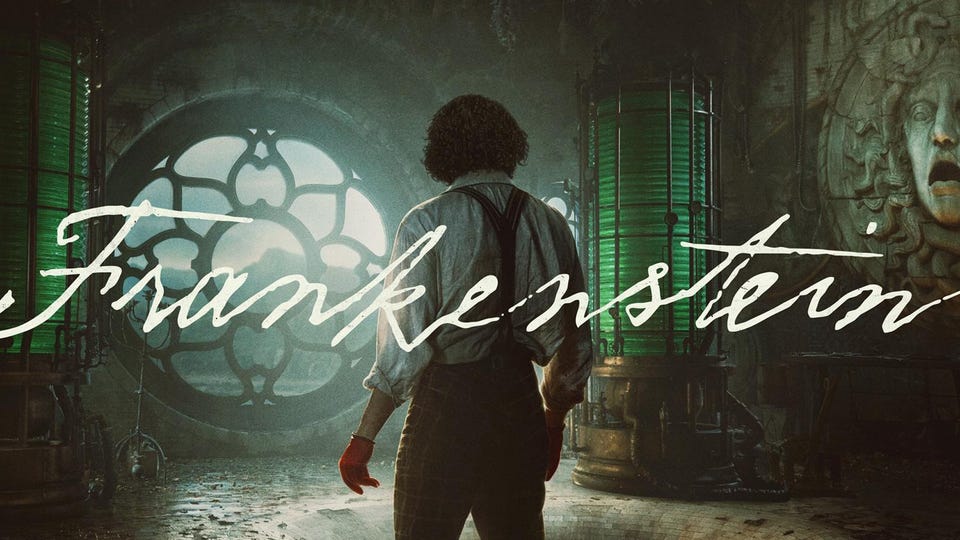
Some films entertain you; others wound you. Once in a long while, one drags you down into the basement of your own psyche and forces you to confront the thing breathing in the dark corner—the thing with your face. Guillermo del Toro’s Frankenstein is that film. It is not a story, nor a spectacle, nor even a reinterpretation. It is a psychological extraction. A mirror. A prophecy. I left the theater shaken, not because the movie was frightening, but because it was familiar. It felt like someone had reached into the modern soul, pulled out its hidden moral cowardice, and placed it on the operating table under surgical lights. As the narration warns: “Some of what I will tell you is fact. Some is not. But it is all true.” Mary Shelley herself could have whispered it.
To understand the force of del Toro’s adaptation, you must see Mary Shelley not as an icon, but as a haunted teenager desperate for meaning in a world eager to use her but reluctant to love her. She was eighteen: pregnant, ostracized, motherless, repeatedly abandoned by Percy Shelley—the brilliant pagan poet who could conjure worlds but not keep promises. She carried grief the way some carry daggers: close to the bone. Born to Mary Wollstonecraft, who died giving her life, Shelley grew up surrounded by the wreckage of brilliance and the weight of ideas too heavy for childhood. When she wrote Frankenstein, she was not spinning horror; she was transcribing her nightmares. Shelley understood that creation without compassion—power without responsibility—becomes not progress, but violence.
Her novel is not about a monster; it is about the man who creates him and then flees from the consequences.
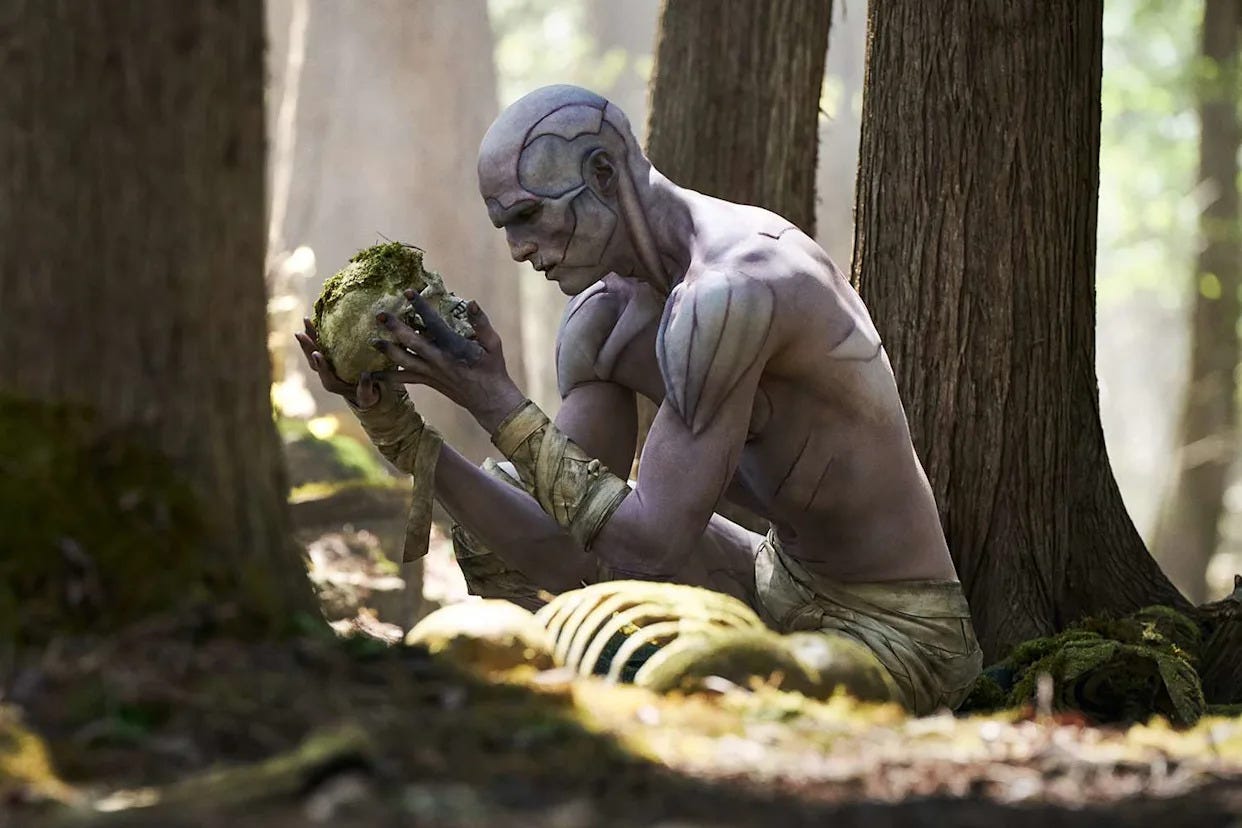
The book itself does not need a detailed plot retelling to feel its teeth. Frankenstein is a meditation on what it means to abandon what you have made. Victor Frankenstein, a brilliant but emotionally stunted young scientist, dares to conquer the boundary between life and death, only to recoil in disgust from the being he animates. Shelley asks one piercing question: Who is the true monster—the creature thrown naked into the world, or the father who runs from him? In an age where we manipulate genomes, forge artificial intelligence, and craft technologies we barely comprehend, Shelley’s voice echoes with prophetic clarity.
If you bring something into the world, she insists, you are morally responsible for it. The chaos is not in the creation; the chaos is in the creator who refuses to be a parent.
Enter Guillermo del Toro—a man whose entire filmography feels like a pilgrimage toward this very story. For thirty years he has explored the souls of misunderstood creatures: the faun and the orphan in Pan’s Labyrinth; the amphibian lover in The Shape of Water; the red-skinned demon yearning for purpose in Hellboy; the ghostly children of The Devil’s Backbone; the romantic ghosts of Crimson Peak; the monstrous machinery of Pacific Rim; the vampiric hunger of Blade II; and even the insectoid paranoia of Mimic and the crimson horror of Cronos.
Del Toro has always been obsessed with one question: What if the monster is the most human being in the story?
In Frankenstein, he finally arrives at the answer.
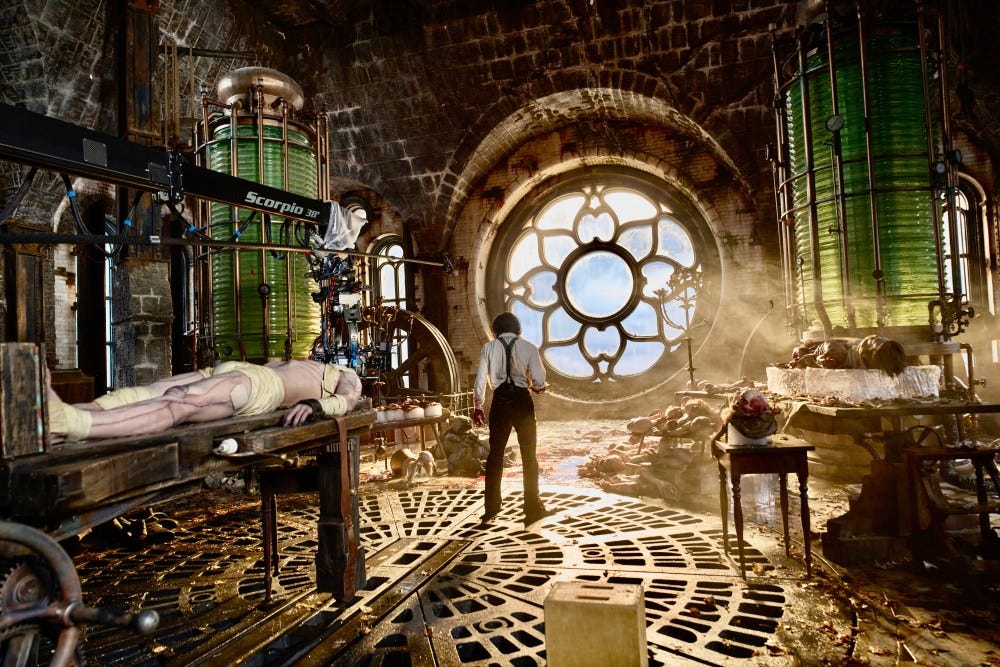
Oscar-winning director Guillermo del Toro adapts Mary Shelley’s classic tale of Victor Frankenstein, the brilliant yet egotistical scientist who brings a creature to life through an experiment that becomes the undoing of both the creator and his tragic creation. But del Toro does not merely film the story. He excavates it. Victor is no longer simply ambitious; he is infected—by grief, by longing, by a pathological refusal to accept human limits. He is the archetype Peterson warns about: the man who refuses responsibility, who flees discipline, who wants power without transformation. And the Creature, towering and tormented, becomes the moral center of the film—the being who bleeds, longs, grieves, learns, and, in his own distorted way, loves. Del Toro preserves Shelley’s devastating inversion: the more Victor strives to become godlike, the less human he becomes, while the more the Creature suffers, the more soul he displays.
At the heart of the film is a line that lands like a hammer on the conscience: “Choice is the seat of the soul. The one gift God granted us.” This is not sentimental. It is an indictment. In a culture captive to the gospel of excuses—psychological determinism, biological inevitability, ideological victimhood—del Toro resurrects Shelley’s ancient wisdom: you are what you choose. Freedom is not the absence of constraint; it is the presence of responsibility. The soul is not forged in comfort; it is forged in agency, sacrifice, and moral courage. Victor cannot face this truth. The Creature, paradoxically, can.
Del Toro intertwines the story with Shelley’s own trauma. One of the most harrowing scenes is Victor recalling his mother’s death: “My mother, whom I had come to consider a part of my very self… was now death. Her eyes extinguished, her smile feeding the cold earth.” This is not merely poetic anguish. Shelley herself lived under the ghost of her mother’s absence. Del Toro knows that grief shapes the psyche like heat shapes metal. Victor is not driven by scientific curiosity—he is driven by the desire to defy the pain that shaped him. He is trying to resurrect what he lost. He is trying to steal fire from the gods because he is terrified of being merely human.
What many viewers miss is that Frankenstein is also one of the earliest feminist novels—but not the sloganized feminist ideology of today. Shelley critiques something far older and far deeper: the male impulse to create without nurturing, to dominate without loving, to invent without considering the lives affected by one’s inventions. She exposes the cost of male genius divorced from female wisdom. Her story echoes in modern films like Poor Things, Birth/Rebirth, and The Angry Black Girl and Her Monster, which revisit the human cost of creation done in a vacuum of compassion. Del Toro’s film honors this undercurrent, not with ideological preaching but with moral clarity: creation without care is cruelty.
Why does this 2025 adaptation matter so urgently? Because we live in Victor’s world. Ours is an age of artificial intelligence, genetic manipulation, and technologies that rewrite the boundaries of life itself. We can build things that think, move, replicate, and respond. But we cannot build souls. The danger is not the creature. The danger is the creator who refuses responsibility. Shelley foresaw the age of godlike power without godlike virtue. Del Toro films it.
In the end, Frankenstein is not just breathtaking. It is not simply a masterpiece. It is a warning. A gothic sermon. A psychological confession. A myth for an age that has forgotten what humans are. And perhaps the darkest truth—whispered by Shelley in 1818 and shouted by del Toro in 2025—is this: the monster was never the Creature. It was always the the one who made him.